


If you want stronger organic visibility, better internal linking, and a more organized website, you need more than random blog posts. You need a structure that helps search engines understand your content and helps users move naturally from one page to another. That is where Topic Clusters for SEO make a real difference.
Many websites publish useful articles but still struggle to build topical authority. The problem is not always content quality. In many cases, the issue is content structure. When pages are disconnected, overlapping, or built without a clear plan, search engines get weaker signals. Users also leave faster because they do not see an obvious next step.
This is why Topic Clusters for SEO have become such an important part of modern SEO. They create a framework where one main page covers a broad topic and several related pages support it in a meaningful way. That structure improves crawling, indexing, internal linking, and content relevance at the same time.
In this guide, we will break down how to build Topic Clusters for SEO, how to connect them to a smart SEO Content Plan Guide, and how to use them to strengthen your Content SEO strategy for long term growth.
Table of Contents
What Are Topic Clusters for SEO?
Topic Clusters for SEO are a content organization model built around one broad pillar page and several related cluster pages. The pillar page covers a big topic at a high level, while the supporting pages go deeper into specific subtopics.
For example, if your main topic is technical SEO, your pillar page may target the broad subject, while cluster pages may cover crawling, indexing, site speed, schema, canonical tags, and internal linking.
This approach works because search engines no longer evaluate pages in isolation. They try to understand relationships between topics, subtopics, search intent, and site structure. When your content is grouped logically, your website becomes easier to understand.
That is the core reason Topic Clusters for SEO are so effective. They show search engines that your site does not just mention a topic once. It covers that topic in depth.
Why Topic Clusters Matter in Modern SEO?
Search has changed. Ranking well today is not only about placing keywords on a page. It is also about context, intent, internal linking, depth, and content relationships. This is why Topic Clusters for SEO support modern ranking goals so well.
Here is what they help you improve:
Stronger topical authority
When you publish multiple connected pieces around one subject, search engines can see that your site covers the topic comprehensively. That strengthens relevance.
Better internal linking
A cluster model gives you a natural reason to link pages together. This improves page discovery and helps pass authority across related content.
Clearer site architecture
Organized structures are easier to crawl and easier for users to navigate. That supports both SEO and user experience.
Reduced keyword overlap
A good cluster strategy assigns a clear purpose to each page. That lowers the chance of publishing multiple pages that compete for the same search intent.
Better user journeys
Readers rarely want one answer only. They often want the next answer too. Topic Clusters for SEO guide them from a broad topic to a specific solution.
The Core Structure of Topic Clusters for SEO
To build effective Topic Clusters for SEO, you need to understand the three foundational parts.
1. Pillar page
This is the main page targeting a broad topic. It should give readers a complete overview while leaving room for deeper related pages.
2. Cluster pages
These are focused supporting articles that answer narrower questions or cover specific subtopics in detail.
3. Internal linking system
The pillar page links to cluster pages, cluster pages link back to the pillar, and relevant cluster pages can also link to one another when the connection makes sense.
Without all three parts working together, Topic Clusters for SEO lose much of their value.
How to Choose the Right Core Topic?
The success of Topic Clusters for SEO starts with choosing the right broad topic. If your core topic is too narrow, you will run out of supporting ideas. If it is too broad, your cluster becomes messy and unfocused.
A strong core topic should meet these conditions:
- It should match your business, service, audience, or niche
- It should have enough search demand to justify deeper coverage
- It should support several related subtopics
- It should allow both beginner and advanced content
- It should offer long term value instead of short term curiosity
A practical way to choose a topic is to ask, “Can I create one strong pillar page and at least eight to fifteen useful supporting articles around this subject?” If the answer is yes, you likely have a good cluster opportunity.
How to Build Topic Clusters for SEO Step by Step?
Now let us get practical. Building Topic Clusters for SEO is not difficult when you follow a clear system.
Step 1: Pick one primary topic
Start with one broad theme closely related to your site goals. This topic should be large enough to support multiple pieces of content but focused enough to stay relevant.
Examples include:
- Technical SEO
- Local SEO
- Link building
- Keyword research
- Content strategy
- On page SEO
Do not start with too many themes at once. Build one cluster properly first.
Step 2: Identify the pillar keyword
Your pillar page should target the broadest high value keyword in that topic area. This page becomes the central resource around which your cluster is built.
For this article, the main phrase is Topic Clusters for SEO. In your own strategy, the pillar keyword should reflect the primary subject users search for.
Step 3: Find supporting subtopics
This is where your cluster starts taking shape. Look for related questions, long tail phrases, pain points, and supporting concepts.
For a pillar page on Topic Clusters for SEO, strong cluster ideas may include:
- what is a pillar page
- internal linking for topic clusters
- how to avoid keyword cannibalization
- content mapping for SEO
- topical authority in search
- how to plan cluster content
- topic cluster mistakes to avoid
The goal is not to force dozens of pages. The goal is to create a set of pages that genuinely support the main topic.
Step 4: Group keywords by intent
One of the biggest strengths of Topic Clusters for SEO is that they allow you to organize content by search intent.
You may have:
- informational pages for beginners
- strategic pages for planners
- practical guides for action takers
- comparison pages for decision makers
- problem solving pages for users facing issues
Grouping by intent helps you create a better SEO Content Plan Guide because it shows what kind of content belongs where.
Step 5: Build the pillar page first
Your pillar page should cover the topic broadly and clearly. It should introduce the main idea, explain why it matters, and link to supporting content where deeper detail is needed.
A pillar page is not meant to answer every question in full depth. It should be broad enough to rank for the main topic and useful enough to guide readers into the rest of the cluster.
This is one reason Topic Clusters for SEO outperform random content publishing. The pillar page acts like a content hub.
Step 6: Create supporting cluster pages
Each cluster page should focus on one clear angle. Do not try to target multiple unrelated intents on the same page. One page should solve one main need well.
If one article starts trying to answer too many different questions, it becomes harder to rank and harder to read.
That is why Content SEO benefits so much from clustering. You create deeper, cleaner content with a stronger purpose.
Step 7: Add strategic internal links
This is where Topic Clusters for SEO become powerful. Internal links are not just navigational tools. They are contextual signals.
Your linking pattern should usually look like this:
- Pillar page links to every important supporting page
- Every cluster page links back to the pillar page
- Cluster pages link to related cluster pages when useful
Use natural anchor text. Keep links relevant. Make sure they help readers, not just search engines.
Step 8: Keep URLs and headings clean
Your structure should be easy to understand. Clean URLs, logical headings, and strong on page organization help both users and crawlers.
Good structure supports:
- better crawlability
- better readability
- better snippet potential
- stronger voice search clarity
When your pages are structured clearly, Topic Clusters for SEO become easier to scale.
Step 9: Publish with consistency
Do not publish one pillar page and disappear. A cluster becomes stronger as supporting content grows over time.
A simple publishing flow may look like this:
- publish the pillar page
- publish three to five core cluster pages
- interlink them properly
- review gaps
- expand with additional supporting articles
This turns your content plan into a system rather than a one time campaign.
Step 10: Review performance and improve
A strong cluster strategy needs maintenance. Watch how pages perform and refine them over time.
Track:
- impressions
- clicks
- rankings
- internal link flow
- indexed pages
- engagement signals
The best Topic Clusters for SEO are built, measured, and improved continuously.
How Topic Clusters Support Topical Authority?
Topical authority is built when your site shows depth, consistency, and the relevance on a subject. Search engines want to rank pages that clearly understand a topic and cover it in a meaningful way.
This is exactly what Topic Clusters for SEO help you do.
Instead of publishing scattered articles across unrelated themes, you build depth around one central subject. That creates stronger topical signals. It also helps your newer pages gain support from older connected pages.
When your site structure shows clear expertise, your entire content network becomes stronger.
Topic Clusters for SEO and Internal Linking
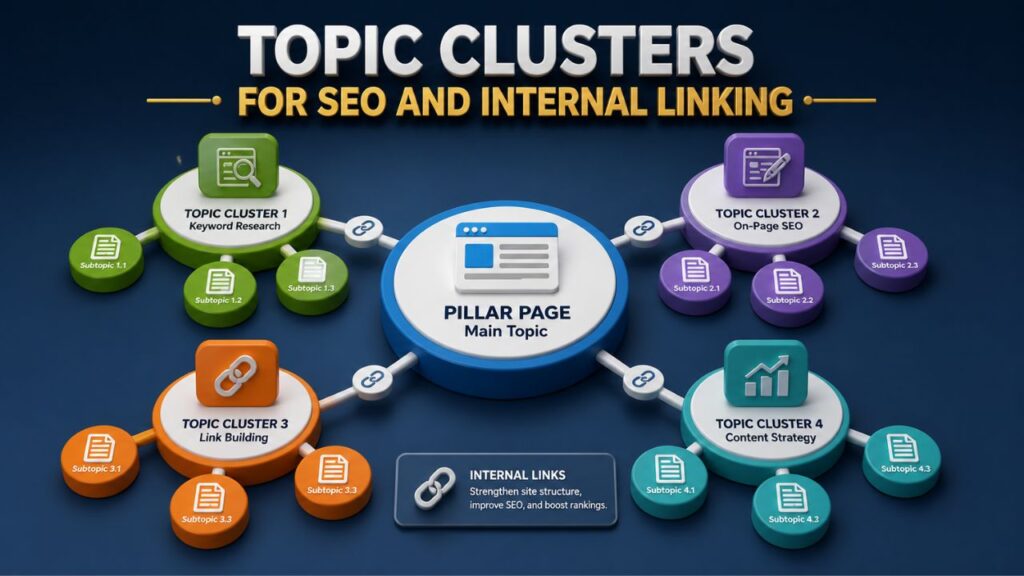
Internal linking is one of the most practical benefits of clustering. Many sites know internal linking matters, but they do not know how to do it naturally. With Topic Clusters for SEO, the linking opportunities become obvious.
A healthy internal linking structure helps:
- distribute authority to important pages
- guide users to related answers
- improve crawl paths
- support ranking context
- strengthen pillar pages
This is why a cluster strategy should always be part of your broader SEO process. It gives internal linking purpose and direction.
How Topic Clusters Fit Into an SEO Content Plan Guide?
If you are building a long term content strategy, Topic Clusters for SEO should sit at the center of your planning framework. A smart SEO Content Plan Guide is not just a list of titles. It is a roadmap that connects topics, intent, page roles, and linking opportunities.
When you use clusters inside your planning process, you can:
- avoid random publishing
- map keywords more clearly
- assign one intent per page
- build supporting content around money pages
- update content more easily
- scale content without losing structure
This makes your planning stronger and your output more strategic.
How Topic Clusters Improve Content SEO?
Strong Content SEO is not only about writing optimized articles. It is about building a content ecosystem that makes sense.
Topic Clusters for SEO improve Content SEO because they help you:
- create content with a clear role
- align pages with user intent
- reduce duplication
- improve semantic relevance
- strengthen contextual linking
- keep your site organized as it grows
If your current content feels disconnected, topic clusters can fix that. They bring structure to content that may already exist and give direction to content you create next.
Common Mistakes to Avoid
Even good strategies can fail when execution is weak. Here are some common mistakes that weaken Topic Clusters for SEO.
Choosing a topic that is too broad
If your pillar topic is too large, the cluster becomes hard to manage. Stay strategic.
Creating thin cluster pages
Every supporting article should add value. Thin pages weaken trust and add little authority.
Ignoring search intent
Do not build pages only around keywords. Build them around what users actually want.
Forgetting internal links
Without good linking, the cluster loses structure and signal strength.
Publishing overlapping pages
Each article should have a clear angle. Overlap leads to confusion and cannibalization.
Not updating old content
You may already have pages that can be merged into a new cluster. Review them before creating everything from scratch.
Are Topic Clusters Still Effective for SEO?
Yes, absolutely. In fact, Topic Clusters for SEO are even more useful now because search engines are better at understanding relationships between concepts, entities, and supporting content.
Search results increasingly reward:
- intent match
- semantic relevance
- depth of coverage
- clean site architecture
- strong internal linking
That means websites with clear topic structures have a better chance of building sustainable visibility.
So if you are asking whether Topic Clusters for SEO still work, the answer is yes. They are not a trend. They are a practical content framework that aligns with how search works today.
Final Thoughts
If you want stronger rankings, more organized content, and a better user journey, Topic Clusters for SEO are worth building. They help you move beyond disconnected blog publishing and create a system that supports growth over time.
The best part is that you do not need to rebuild your entire site overnight. You can start with one pillar topic, create a few strong supporting pages, link them strategically, and expand from there.
That is how real momentum starts.
When you combine Topic Clusters for SEO with a focused SEO Content Plan Guide, stronger internal linking, and better Content SEO, you create a site structure that is easier to scale and easier for search engines to trust.
If your goal is to reach the first page of Google, structure matters as much as content quality. And this is one of the smartest ways to build that structure.
Frequently Asked Questions
What are Topic Clusters for SEO?
Topic Clusters for SEO are a content strategy model where one pillar page covers a broad topic and several linked cluster pages cover related subtopics in more detail.
How many cluster pages should one pillar page have?
There is no fixed number. A good starting point is five to ten strong supporting pages, then expand based on opportunity and relevance.
Do topic clusters help with internal linking?
Yes. They create a natural internal linking structure that helps both users and search engines understand content relationships.
Are topic clusters useful for small websites?
Yes. Small websites can benefit a lot from Topic Clusters for SEO because clusters help build authority faster around selected topics.
What is the difference between a pillar page and a cluster page?
A pillar page covers the main topic broadly. A cluster page covers one narrower part of that topic in more depth.
How do topic clusters improve Content SEO?
They improve Content SEO by organizing content clearly, aligning pages with search intent, and creating stronger semantic, and internal linking signals.


