


Mobile devices have transformed the way people search, browse, shop, and interact online. Today, the majority of internet users access websites through smartphones and tablets, making mobile optimization a critical factor for online success. If your website fails to deliver a smooth mobile experience, you risk losing valuable traffic, engagement, and conversions.
This comprehensive Mobile SEO Guide explains everything you need to know about improving search visibility on mobile devices. From understanding mobile first indexing and page speed optimization to enhancing user experience and preparing for AI powered search, this guide covers the strategies that can help your website achieve better search rankings.
Whether you are a business owner, marketer, blogger, or SEO professional, learning how to improve mobile search rankings is essential for staying competitive in today’s digital landscape.
By following the recommendations in this guide, you can strengthen your mobile SEO strategy for businesses, increase mobile organic traffic growth, and improve search visibility on mobile devices.
Table of Contents
Understanding Mobile SEO Fundamentals
What Is Mobile SEO?
Mobile SEO refers to the process of optimizing a website so that it performs effectively on smartphones and tablets while maintaining strong visibility in search engine results.
A successful mobile SEO optimization guide focuses on improving user experience, loading speed, content accessibility, navigation, and technical performance for mobile visitors.
The goal is simple: help users find your content quickly and interact with it easily regardless of the device they use.
What Is Mobile SEO and Why Is It Important?
Mobile SEO is important because search engines increasingly prioritize mobile experiences when determining rankings.
Modern consumers expect:
- Fast loading pages
- Responsive layouts
- Easy navigation
- Readable content
- Quick access to information
If your website fails to meet these expectations, users often leave within seconds. This can negatively impact engagement metrics and search performance.
A strong mobile search engine optimization strategy helps:
- Improve user satisfaction
- Increase mobile organic traffic
- Enhance conversion opportunities
- Support local search visibility
- Strengthen overall SEO performance
How Mobile SEO Impacts Search Rankings
Search engines analyze numerous mobile ranking factors in Google when evaluating websites.
These include:
- Mobile page speed optimization
- Core Web Vitals for mobile SEO
- Mobile usability optimization techniques
- Responsive web design
- Mobile crawlability and indexing
- Mobile user experience ranking signals
When these elements are optimized, search engines are more likely to reward your website with better visibility in mobile search results.
Mobile SEO Strategy for Businesses
Businesses that invest in mobile SEO often experience improved customer engagement and stronger search performance.
An effective mobile SEO strategy for businesses typically includes:
- Mobile first website development
- Technical SEO improvements
- Content optimization
- Local SEO enhancements
- Voice search readiness
- AI search optimization
These efforts work together to improve the overall mobile search experience.
How Google Evaluates Mobile Websites
Google’s Mobile First Indexing Explained
Google now primarily evaluates the mobile version of a website when determining rankings and indexing content.
This process is known as mobile first indexing.
Google Mobile First Indexing Guide
Under mobile first indexing, Google examines:
- Mobile content
- Mobile navigation
- Internal links
- Structured data
- Page speed
- User experience
If the mobile version of your site lacks content or functionality available on desktop, rankings may be affected.
How Does Mobile First Indexing Affect Rankings?
Many website owners ask:
How does mobile first indexing affect rankings?
The answer is straightforward. Search engines rely heavily on the mobile version of your website to understand and rank your content.
A poorly optimized mobile experience can lead to:
- Reduced visibility
- Lower engagement
- Crawling challenges
- Indexing issues
Conversely, websites that follow mobile indexing best practices often achieve stronger search performance.
How Google Ranks Mobile Websites
Google evaluates several mobile ranking factors, including:
Content Quality
Relevant, valuable, and comprehensive content remains essential.
Mobile Performance
Fast loading pages contribute to better user satisfaction.
User Experience
Easy navigation and readability improve engagement.
Technical SEO
Proper indexing, structured data, and crawlability help search engines understand content.
Engagement Metrics
Strong user interaction often signals content quality and relevance.
Google Mobile Friendliness Guidelines
Google recommends websites:
- Use responsive design
- Avoid intrusive interstitials
- Maintain readable text sizes
- Ensure clickable elements are properly spaced
- Optimize images and media
Following these guidelines supports mobile SEO for Google search and improves user satisfaction.
Mobile Friendly SEO Best Practices
Mobile Website Optimization for SEO
Effective mobile website optimization for SEO involves balancing user experience with technical performance.
Mobile Friendly SEO Best Practices
To create a strong mobile foundation, focus on:
- Responsive design
- Fast loading pages
- Accessible content
- Optimized navigation
- Mobile friendly forms
Mobile Navigation SEO Best Practices
Navigation significantly impacts usability and engagement.
Best practices include:
- Clear menu structures
- Sticky navigation when appropriate
- Easy access to important pages
- Minimal navigation clutter
- Search functionality
When users can find information quickly, they tend to stay longer and interact more with your content.
Mobile Content Optimization Strategies
Content should be designed specifically for mobile consumption.
Recommended strategies include:
- Short paragraphs
- Descriptive headings
- Bullet points
- Scannable formatting
- Concise introductions
These mobile content optimization strategies improve readability and engagement.
Mobile Readability SEO Tips
To improve readability:
- Use simple language
- Increase font size appropriately
- Maintain sufficient spacing
- Break up large content blocks
- Use visual elements strategically
Touch Friendly Mobile Website Design
Touch friendly design improves usability by ensuring buttons and interactive elements are easy to tap.
Benefits include:
- Reduced frustration
- Improved engagement
- Better conversion rates
- Enhanced user experience
Mobile Website Accessibility for SEO
Accessibility helps both users and search engines understand your content.
Consider:
- Alternative image text
- Keyboard navigation support
- Proper heading structures
- Color contrast optimization
- Screen reader compatibility
Accessibility improvements often contribute to stronger mobile search performance.
Mobile First Indexing SEO Guide
Preparing Your Site for Mobile First Indexing
Proper preparation is essential for long term success.
Mobile Indexing Best Practices
Follow these recommendations:
- Maintain consistent content across devices
- Optimize structured data
- Ensure mobile crawlability and indexing
- Improve loading speed
- Monitor technical performance
Mobile Crawlability and Indexing
Search engines must be able to access and understand mobile pages efficiently.
Common issues include:
- Blocked resources
- Broken links
- Redirect chains
- Duplicate content
- Improper canonical implementation
Resolving these issues strengthens indexing and visibility.
How to Optimize a Website for Mobile SEO?
To optimize a website for mobile SEO:
- Improve page speed
- Use responsive design
- Enhance navigation
- Optimize content layout
- Implement structured data
- Monitor Core Web Vitals
- Improve accessibility
- Reduce usability issues
These actions create a stronger foundation for higher rankings and better user experiences.
Mobile Technical SEO Optimization
Technical Mobile SEO Checklist
While content and user experience are important, technical optimization forms the backbone of a successful mobile SEO strategy. Even the best content can struggle to rank if search engines encounter issues crawling, indexing, or rendering your mobile pages.
A thorough mobile technical SEO audit checklist helps identify hidden problems that may prevent your website from achieving its full ranking potential.
Why Technical Mobile SEO Matters
Technical SEO ensures that:
- Search engines can access your content
- Pages load efficiently
- Users experience smooth navigation
- Mobile devices properly render content
- Important pages receive adequate visibility
When technical issues remain unresolved, they can negatively affect rankings, engagement, and conversions.
Mobile Technical SEO Audit Checklist
A complete audit should include the following areas:
Mobile Crawlability
Search engines must be able to access your website without restrictions.
Review:
- Robots.txt directives
- XML sitemaps
- Internal linking structure
- Broken links
- Redirect chains
Mobile Indexability
Ensure important pages are eligible for indexing.
Check:
- Meta robots tags
- Canonical tags
- Duplicate content issues
- Noindex directives
- Orphan pages
Mobile Site Architecture
A clean structure helps both users and search engines.
Best practices include:
- Logical hierarchy
- Clear navigation paths
- Consistent internal linking
- Shallow click depth
Mobile Rendering
Search engines need to render pages correctly.
Evaluate:
- JavaScript rendering
- CSS accessibility
- Mobile viewport settings
- Interactive elements
Mobile Structured Data Implementation
Structured data helps search engines better understand your content.
Common schema types include:
- Article Schema
- FAQ Schema
- Breadcrumb Schema
- Organization Schema
- Local Business Schema
- Product Schema
Proper mobile structured data implementation can improve eligibility for enhanced search features and rich results.
Fixing Mobile Usability Issues in SEO
Mobile usability issues can reduce rankings and frustrate visitors.
Common problems include:
- Text too small to read
- Clickable elements too close together
- Content wider than the screen
- Viewport configuration errors
- Poor mobile layouts
Regular audits help identify and resolve these concerns before they impact performance.
How to Fix Mobile Usability Issues?
Start by:
- Using responsive layouts
- Increasing font readability
- Optimizing button sizes
- Improving spacing between interactive elements
- Testing across multiple devices
Consistent monitoring supports long term mobile website ranking improvement.
Mobile Page Speed Optimization
Why Mobile Speed Matters
- Speed remains one of the most influential factors in mobile search performance.
- Mobile users expect websites to load almost instantly. Even small delays can increase abandonment rates and reduce engagement.
- This is why mobile page speed optimization plays a critical role in search visibility and user satisfaction.
Why Mobile Page Speed Matters for SEO
A fast website helps:
- Improve user experience
- Increase engagement
- Reduce bounce rates
- Enhance crawl efficiency
- Support higher rankings
Search engines prioritize websites that deliver fast and reliable experiences across mobile devices.
Mobile Website Loading Speed Improvement
Several factors contribute to faster loading times.
Optimize Images
Large image files often slow down mobile websites.
Best practices:
- Compress images
- Use modern formats
- Serve responsive images
- Implement lazy loading
Minimize Code
Reduce unnecessary:
- JavaScript
- CSS
- HTML bloat
Cleaner code contributes to faster page rendering.
Enable Browser Caching
Caching allows returning visitors to access pages more quickly by storing certain resources locally.
Improve Server Performance
Reliable hosting and optimized servers help reduce loading delays.
Core Web Vitals for Mobile SEO
Core Web Vitals are performance metrics that evaluate user experience.
They help search engines measure how visitors interact with your pages.
Largest Contentful Paint (LCP)
- Measures loading performance.
- A good LCP score indicates that primary content appears quickly.
Interaction to Next Paint (INP)
- Measures responsiveness.
- Fast response times improve usability and engagement.
Cumulative Layout Shift (CLS)
- Measures visual stability.
- Pages should remain stable while loading to prevent accidental clicks and poor experiences.
How to Improve Mobile Website Performance
To improve mobile performance:
- Compress images
- Minify resources
- Reduce redirects
- Improve hosting quality
- Use content delivery networks
- Optimize scripts
- Monitor Core Web Vitals regularly
These improvements contribute directly to better mobile search engine optimization results.
Responsive Design vs AMP
Choosing the Right Mobile Framework
- Businesses often compare AMP and responsive design when developing mobile experiences.
- Understanding the differences helps determine the most effective approach.
AMP vs Responsive Design for SEO
- AMP was designed to create extremely fast mobile pages.
- Responsive design focuses on creating a single website that adapts to different screen sizes.
- Today, responsive design is generally the preferred option because it provides flexibility, easier maintenance, and a consistent user experience.
Responsive Web Design SEO Benefits
Responsive websites offer several advantages:
- Single URL structure
- Easier management
- Better user experience
- Improved crawl efficiency
- Simplified analytics tracking
These responsive web design SEO benefits support long term search performance.
When AMP May Still Be Useful?
AMP can still benefit certain scenarios where speed is the primary concern.
Examples include:
- News websites
- Content publishers
- High volume informational content
However, many modern websites achieve excellent performance without AMP.
Which Option Is Better for Rankings?
For most businesses, responsive design provides the best balance between performance, usability, and SEO.
Combined with strong page speed optimization and user experience improvements, responsive websites can compete effectively in mobile search results.
Mobile User Experience and SEO
Mobile UX and SEO Optimization
- User experience has become one of the most important components of modern SEO.
- Search engines increasingly evaluate how visitors interact with websites when determining rankings.
Mobile User Experience Ranking Signals
Several factors influence mobile rankings:
- Loading speed
- Readability
- Navigation quality
- Visual stability
- Accessibility
- Engagement metrics
Improving these signals supports stronger mobile search performance.
Mobile User Experience Improvements
Small enhancements often create significant results.
Examples include:
- Simplified navigation
- Faster loading pages
- Better typography
- Improved spacing
- Clear calls to action
These changes contribute to higher satisfaction and engagement.
Improving Mobile User Engagement
Engaged visitors spend more time interacting with content.
Strategies include:
- Creating valuable content
- Improving readability
- Using clear headings
- Adding visual elements
- Encouraging interaction
Improved engagement often supports stronger rankings over time.
Mobile Navigation SEO Best Practices
Navigation directly influences both usability and SEO.
Effective navigation should:
- Be easy to understand
- Require minimal taps
- Highlight important pages
- Support internal linking
Well designed navigation helps users discover more content and improves crawlability.
Reducing Mobile Bounce Rate
A high bounce rate may indicate poor user experience.
To reduce bounce rates:
- Improve page speed
- Match content with search intent
- Simplify navigation
- Enhance readability
- Optimize mobile layouts
These improvements encourage visitors to remain on the website longer.
Mobile Conversion Rate Optimization SEO
- Traffic alone is not enough.
- Successful mobile SEO also focuses on conversions.
Optimization opportunities include:
- Simplified forms
- Faster checkout experiences
- Better calls to action
- Mobile friendly contact options
- Improved trust signals
Combining conversion optimization with SEO creates stronger business outcomes.
Mobile Content Optimization
Creating Content for Mobile Users
- Content that performs well on desktop may not always work effectively on mobile devices.
- Mobile visitors often scan content quickly and seek immediate answers.
Mobile Search Intent Optimization
Understanding user intent is essential.
Mobile users typically search for:
- Quick answers
- Local information
- Product research
- Directions
- Immediate solutions
Aligning content with these needs improves satisfaction and rankings.
Mobile Content Optimization Strategies
Effective content strategies include:
- Clear headings
- Short paragraphs
- Concise explanations
- Visual hierarchy
- Actionable information
These improvements help users consume content more efficiently.
Mobile Content Marketing SEO
Content marketing remains an important component of mobile SEO.
Focus on:
- Comprehensive topic coverage
- Question based content
- Evergreen resources
- Topical authority development
- Internal content connections
These practices improve search visibility and authority.
Mobile Readability SEO Tips
Improving readability helps users stay engaged.
Recommendations include:
- Using simple language
- Avoiding large text blocks
- Incorporating bullet points
- Maintaining adequate spacing
- Writing conversationally
Mobile Search Performance Metrics
Track key metrics such as:
- Mobile organic traffic
- Engagement rate
- Conversion rate
- Average session duration
- Core Web Vitals
- Search visibility
Monitoring these indicators helps identify opportunities for ongoing optimization.
Cross Device SEO Optimization
Users frequently switch between devices before completing actions.
Cross device SEO optimization ensures a consistent experience across:
- Smartphones
- Tablets
- Laptops
- Desktop computers
Consistency strengthens user trust and improves overall search performance.
Mobile Local SEO Optimization
Mobile SEO for Local Businesses
Mobile searches frequently involve local intent. Users often search for products, services, and businesses while on the move, making local optimization an essential component of any successful Mobile SEO Guide.
Businesses that invest in mobile local SEO optimization can increase visibility among nearby customers who are actively searching for solutions.
Why Mobile Local Searches Matter?
Local mobile searches typically occur when users need immediate information.
Examples include:
- Finding nearby stores
- Locating service providers
- Searching for directions
- Checking operating hours
- Reading reviews
These searches often lead to high conversion rates because the user’s intent is clear.
Local Search Rankings on Mobile Devices
Search engines use several signals to determine local rankings:
- Relevance
- Distance
- Prominence
- Business information accuracy
- Mobile user experience
Optimizing these factors helps improve local search rankings on mobile devices.
Mobile Google Business Profile Optimization
A well optimized business profile can significantly improve local visibility.
Best practices include:
- Maintaining accurate business details
- Adding high quality images
- Updating operating hours
- Responding to customer reviews
- Selecting appropriate categories
Mobile Google Business Profile optimization supports stronger visibility in local search results and map listings.
Mobile Maps and Local SEO
Many users rely on map applications when searching for businesses.
To improve visibility:
- Ensure location consistency
- Use accurate contact information
- Build local citations
- Optimize local landing pages
These strategies strengthen mobile maps and local SEO performance.
Optimizing for Mobile Local Intent
When creating content, focus on location based queries and user needs.
Examples include:
- Service area pages
- Local guides
- Frequently asked questions
- Location specific content
This approach helps search engines better understand local relevance.
Mobile SEO for Nearby Searches
Nearby searches continue to grow as mobile usage increases.
To improve performance:
- Optimize local keywords
- Use structured data
- Create location specific content
- Maintain accurate business information
Location Based Mobile SEO Strategies
Effective strategies include:
- Local content creation
- Citation management
- Reputation management
- Local link acquisition
- Geographic keyword optimization
These efforts contribute to stronger local mobile search marketing results.
Mobile Voice Search SEO Guide
The Rise of Voice Search
- Voice technology continues to change how people search online.
- Instead of typing short phrases, users now ask complete questions through smartphones and voice assistants.
- This shift makes voice search optimization for mobile increasingly important.
Mobile Voice Search SEO Guide
Voice search queries are often:
- Longer
- Conversational
- Question based
- Intent focused
Businesses that adapt their content accordingly can gain a competitive advantage.
Voice Search Optimization for Mobile
To optimize for voice search:
- Use conversational language
- Answer questions directly
- Create FAQ sections
- Focus on search intent
- Improve page speed
These improvements help align content with modern search behavior.
Mobile SEO for Voice Assistants
Voice assistants prioritize concise and accurate answers.
To improve visibility:
- Structure content clearly
- Use schema markup
- Target question based keywords
- Provide direct answers
This increases the likelihood of appearing in voice search results.
Natural Language Mobile SEO
- Natural language processing allows search engines to better understand context and intent.
- Content should sound natural and address user questions directly.
- Instead of targeting only keywords, focus on creating comprehensive answers that satisfy search intent.
Conversational Search Optimization
Conversational search optimization involves writing content that mirrors how people speak.
Examples include:
- What is mobile SEO and why is it important?
- How to optimize a website for mobile SEO?
- Why mobile page speed matters for SEO?
- How to rank higher in mobile search results?
Including these questions naturally throughout content improves voice search opportunities.
Mobile SEO for AI Search and Generative Search
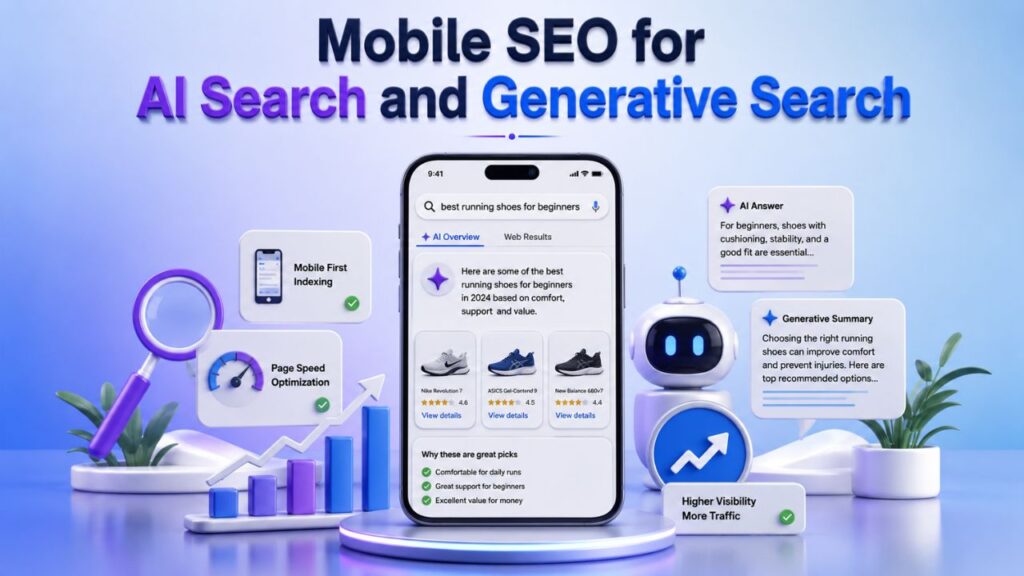
Understanding AI Powered Search
- Search engines are increasingly incorporating artificial intelligence into search experiences.
- AI systems analyze user intent, context, and content quality to provide more relevant answers.
- As a result, AI powered mobile search optimization is becoming a critical component of modern SEO.
Mobile SEO and Generative Search
Generative search experiences often summarize information directly within search results.
To improve visibility:
- Publish comprehensive content
- Demonstrate topical authority
- Use structured formatting
- Include question based sections
- Provide clear explanations
These practices improve eligibility for AI generated search summaries.
Optimizing Mobile Content for AI Search
AI systems favor content that is:
- Well structured
- Factually accurate
- Comprehensive
- Easy to understand
- User focused
Creating content that thoroughly addresses a topic increases the chances of being referenced in AI driven search experiences.
Mobile SEO for Featured Snippets
Featured snippets remain valuable because they often influence AI generated answers.
To improve snippet opportunities:
- Answer questions directly
- Use descriptive headings
- Include numbered lists
- Create concise definitions
- Organize content logically
These techniques support both traditional and AI powered search visibility.
Mobile Search Intent Optimization
Search intent remains one of the strongest ranking factors.
Content should satisfy:
- Informational intent
- Navigational intent
- Commercial intent
- Transactional intent
- Local intent
Matching content with user expectations improves engagement and search performance.
Advanced Mobile SEO Techniques for Higher Rankings
Mobile SEO Techniques for Higher Rankings
As competition increases, advanced optimization strategies become more important.
Mobile SERP Optimization Techniques
Improving search result visibility requires more than ranking alone.
Focus on:
- Compelling title tags
- Optimized meta descriptions
- Structured data implementation
- Rich result eligibility
- Featured snippet opportunities
These enhancements can improve click through rates and traffic.
Improving Mobile Organic Rankings
Sustainable ranking growth requires continuous improvement.
Key areas include:
- Content quality
- User experience
- Technical SEO
- Internal linking
- Authority building
Together, these elements contribute to stronger search performance.
Mobile Search Engine Optimization Tips
To strengthen your mobile SEO strategy:
- Prioritize user experience
- Monitor Core Web Vitals
- Improve crawlability
- Optimize for local searches
- Create comprehensive content
- Focus on voice search
- Prepare for AI search experiences
Optimize Website for Mobile Search Results
A fully optimized mobile website should deliver:
- Fast loading times
- Easy navigation
- Relevant content
- Accessibility
- Strong technical performance
Meeting these expectations helps improve rankings and user satisfaction.
Smartphone Search Optimization
As smartphone usage continues to grow, optimization efforts should focus on mobile first experiences.
Successful websites prioritize:
- Convenience
- Speed
- Readability
- Accessibility
- Relevance
These characteristics contribute to stronger smartphone search optimization.
Complete Mobile SEO Checklist for Beginners
Mobile SEO Checklist
Use this checklist to evaluate your website.
Technical SEO Checklist
✔ Responsive design implemented
✔ XML sitemap submitted
✔ Structured data added
✔ Internal linking optimized
✔ Crawl errors resolved
✔ Mobile indexing verified
Page Speed Checklist
✔ Images compressed
✔ Scripts optimized
✔ Browser caching enabled
✔ Core Web Vitals monitored
✔ Hosting performance reviewed
User Experience Checklist
✔ Navigation simplified
✔ Fonts readable
✔ Buttons touch friendly
✔ Layout stable
✔ Accessibility improved
Content Optimization Checklist
✔ Search intent addressed
✔ Headings structured properly
✔ Content easy to scan
✔ FAQ sections included
✔ Internal links added
Local SEO Checklist
✔ Business information updated
✔ Local keywords targeted
✔ Reviews managed
✔ Local landing pages optimized
Voice Search Checklist
✔ Conversational content created
✔ Question based keywords targeted
✔ Direct answers provided
✔ FAQ schema implemented
AI Search Optimization Checklist
✔ Comprehensive topic coverage
✔ Structured content organization
✔ Entity optimization
✔ Topical authority development
✔ Helpful user focused content
Conclusion
Mobile search continues to shape the future of digital marketing. Businesses that prioritize mobile optimization are better positioned to attract organic traffic, engage users, and achieve sustainable growth.
This Mobile SEO Guide demonstrates that success involves far more than responsive design alone. Modern mobile SEO requires a combination of technical excellence, user experience optimization, content quality, local search visibility, voice search readiness, and AI search preparation.
By implementing mobile first indexing best practices, improving mobile page speed optimization, enhancing user engagement, and optimizing for emerging search technologies, you can create a stronger foundation for long term search success.
As search engines continue evolving, the websites that focus on helping users quickly find relevant information will remain the most competitive. Consistent optimization, regular audits, and a commitment to user experience will help improve mobile website ranking improvement and support lasting organic growth.
The future of search is mobile first, user focused, and increasingly driven by artificial intelligence. Taking action today will help ensure your website remains visible, relevant, and competitive in the years ahead.
Frequently Asked Questions
What is mobile friendly website optimization?
Mobile friendly website optimization involves improving a website’s design, speed, usability, and accessibility so that it performs effectively on smartphones and tablets.
How to optimize a website for mobile SEO?
Improve page speed, implement responsive design, optimize navigation, enhance content readability, and ensure proper indexing and crawlability.
How does mobile first indexing affect rankings?
Search engines primarily evaluate the mobile version of your website when determining rankings and indexing content.
Why mobile page speed matters for SEO?
Faster websites provide better user experiences, reduce bounce rates, improve engagement, and support stronger rankings.
How to improve mobile website performance?
Optimize images, reduce code bloat, improve hosting, monitor Core Web Vitals, and streamline page resources.
What are the best mobile SEO practices?
Responsive design, fast loading pages, strong user experience, technical optimization, voice search readiness, and AI search optimization.
How to rank higher in mobile search results?
Focus on content quality, page speed, technical SEO, user experience, local optimization, and search intent alignment.
How to conduct a mobile SEO audit?
Review crawlability, indexability, page speed, usability, structured data, navigation, and Core Web Vitals.
How to fix mobile usability issues?
Address viewport errors, improve readability, optimize touch elements, and ensure content fits mobile screens properly.
What is mobile SEO and why is it important?
Mobile SEO is the process of optimizing a website for mobile devices. It is important because mobile users represent a significant portion of online traffic, and search engines prioritize mobile experiences when ranking websites


