

AI has changed how marketers research topics, develop content strategies, create drafts, personalize campaigns, and measure performance. But using artificial intelligence does not automatically create an effective content marketing strategy.
The real advantage comes from knowing where AI adds value and where human expertise is essential.
That distinction matters more than ever. Google continues to emphasize helpful, reliable, people first content and warns against creating large amounts of low value content primarily to manipulate search rankings. AI can be part of a strong workflow, but it should help you create something more useful, accurate, original, and relevant for your audience.
For SEO professionals and marketers, this creates an important opportunity.
Instead of treating AI as a replacement for strategy, you can use it as a productivity layer across research, planning, creation, optimization, distribution, and analysis.
This guide explains how to build an effective AI Content Marketing strategy, where AI fits into the workflow, how to optimize AI assisted content for search, which mistakes to avoid, and how to measure whether your investment is actually producing business results.
Table of Contents
What Is AI Content Marketing?
AI Content Marketing is the use of artificial intelligence technologies to support the planning, creation, optimization, personalization, distribution, and analysis of marketing content.
AI can help marketers process large amounts of information, identify patterns, generate ideas, organize research, create initial drafts, summarize data, and automate repetitive tasks.
However, AI Content Marketing is not simply asking an AI tool to write a blog post and publishing the result.
A stronger approach combines:
AI efficiency + human expertise + audience insight + original value + strategic distribution
For example, an SEO professional might use AI to generate a list of potential topics. The marketer can then validate those topics against search intent, competitor coverage, business goals, customer questions, and keyword opportunities.
The AI accelerates the research process. The marketer makes the strategic decisions.
How AI Content Marketing Works?
A practical workflow looks like this:
Research → Strategy → Ideation → Brief → Creation → Human Review → Optimization → Distribution → Measurement → Improvement
Every stage has a different role for AI.
| Marketing activity | How AI can help | Human responsibility |
|---|---|---|
| Topic research | Identify themes and questions | Validate opportunities |
| Content ideation | Generate potential angles | Select useful ideas |
| Brief creation | Organize sections and questions | Define strategic direction |
| Drafting | Produce an initial draft | Add expertise and originality |
| SEO | Suggest related concepts | Validate search intent |
| Personalization | Adapt messaging | Protect brand positioning |
| Distribution | Repurpose content | Select appropriate channels |
| Analytics | Identify patterns | Make business decisions |
The objective is not maximum automation. It is better marketing with less wasted effort.
Why Is AI Content Marketing Important in 2026?
The content environment has become significantly more competitive.
Marketers are no longer competing only for traditional organic listings. Their content may also be discovered through AI powered search experiences, social platforms, video platforms, newsletters, communities, and other discovery channels.
Google’s recent guidance for generative AI search emphasizes valuable, unique, non commodity content and says that traditional SEO fundamentals remain important for AI search experiences as well.
That changes how marketers should think about content.
Search Is Becoming More Conversational
Users increasingly ask detailed questions rather than entering short keyword phrases.
Instead of searching only for:
“content marketing strategy”
a user may search for:
“How can a B2B SaaS company use AI to scale content without publishing generic articles?”
Your content needs to address the underlying problem, not merely repeat the keyword.
Content Production Is Faster
AI can reduce the time required for repetitive tasks.
Research summaries, content briefs, outlines, headline variations, content repurposing, and initial drafts can often be prepared much faster with AI assistance.
That creates a competitive advantage, but only when the saved time is reinvested into strategy and quality.
Personalization Is Becoming More Important
Different customers have different needs.
AI can help marketers adapt messaging according to:
- Industry
- Customer stage
- Search intent
- Product interest
- Geographic market
- Previous interactions
- Content preferences
Personalization becomes particularly valuable when you already have strong customer data and a clear segmentation strategy.
Human Expertise Still Matters
AI can generate plausible information. That does not mean every statement is accurate, useful, or appropriate for your audience.
Your expertise provides the layer AI cannot reliably supply on its own:
- Business context
- First hand knowledge
- Professional judgment
- Brand perspective
- Original insights
- Customer understanding
- Strategic priorities
That human layer is what can turn generic AI output into valuable marketing content.
How to Build an AI Content Marketing Strategy
A successful strategy starts before you open an AI tool.
Step 1: Define Your Marketing Goals
First decide what you want content to accomplish.
Possible objectives include:
- Increase organic visibility
- Generate qualified leads
- Build topical authority
- Increase brand awareness
- Educate prospects
- Improve conversions
- Support sales teams
- Retain existing customers
Your goal determines what content you should create.
If lead generation is the objective, publishing traffic focused articles alone may not be enough. You also need commercial content, comparison pages, service pages, lead magnets, conversion paths, and strong calls to action.
Step 2: Identify Your Target Audience
Define exactly who you want to reach.
For SEO professionals and marketers, useful audience characteristics may include:
- Job role
- Industry
- Business size
- Marketing maturity
- SEO knowledge
- Primary challenges
- Buying authority
- Budget
- Business objectives
The better you understand the reader, the easier it becomes to create content that answers meaningful questions.
Step 3: Map Content to the Customer Journey
Not every visitor is ready to buy.
Your content should support different stages.
Awareness: Educational guides and problem focused articles
Consideration: Comparisons, frameworks, checklists, and solution focused content
Decision: Service pages, case studies, reviews, demonstrations, and pricing information
Retention: Tutorials, knowledge bases, newsletters, and advanced resources
AI can help you identify content gaps across these stages.
Step 4: Build Topic Clusters
Instead of publishing unrelated articles, create groups of connected content.
For example, a central topic such as AI Content Marketing could support related articles covering:
- AI content strategy
- AI SEO
- AI content creation
- Content optimization
- AI writing workflows
- Content personalization
- Content automation
- AI marketing tools
- Content performance measurement
Connect relevant pages through internal links.
This helps users discover related information and gives search engines clearer context about the site’s topical coverage.
Step 5: Create an AI Content Workflow
Define which tasks AI handles and which tasks require human review.
A useful workflow is:
AI research assistance → Human strategy → AI drafting assistance → Human editing → Fact checking → SEO review → Publication → Performance analysis
This approach provides efficiency without surrendering editorial control.
How to Use AI for Content Research
Research is one of the areas where AI can save marketers considerable time.
Find Content Ideas
Ask AI to identify questions, problems, objections, and subtopics associated with your primary subject.
Do not automatically publish every idea.
Filter suggestions based on:
- Audience relevance
- Search intent
- Business relevance
- Competition
- Existing content
- Originality
- Conversion potential
Analyze Search Intent
Search intent is more important than simply inserting a keyword into an article.
Identify whether the searcher wants to:
- Learn something
- Compare solutions
- Find a product
- Hire a service
- Complete a task
- Solve a problem
Then structure your content around that purpose.
Identify Content Gaps
AI can help compare your existing content with competitor topics and identify areas that deserve deeper coverage.
However, the goal should not be to copy competitor headings.
Ask a better question:
What useful information does the reader still need after visiting the existing results?
That question can uncover opportunities for original research, better explanations, clearer processes, expert insights, tools, examples, and practical frameworks.
Research Audience Questions
Use AI to organize customer questions from:
- Sales conversations
- Support tickets
- Search queries
- Surveys
- Community discussions
- Reviews
- Comments
- Website analytics
These sources can produce more useful topics than brainstorming keywords in isolation.
How to Use AI for Content Creation?
AI can support almost every stage of content production.
Generate Content Ideas
Give AI your audience, topic, business objective, and customer problems.
The resulting ideas will be much more useful than simply asking:
“Give me 50 blog topics.”
Specific inputs produce better strategic outputs.
Create Content Briefs
A useful content brief should define:
- Primary topic
- Search intent
- Target audience
- Main question
- Supporting questions
- Key concepts
- Recommended structure
- Internal linking opportunities
- Conversion goal
- Content differentiation
AI can organize this information quickly.
Your SEO team should make the final decisions.
Write First Drafts
AI can help create an initial draft, but the draft should not be treated as the finished product.
Review it for:
- Accuracy
- Originality
- Repetition
- Unsupported claims
- Generic language
- Brand voice
- Search intent
- Missing information
- Subject matter expertise
Then improve it.
Create Headlines and Introductions
AI can produce multiple headline and opening paragraph variations.
Use that capability to test different approaches while keeping the final version accurate and useful.
Avoid sensational headlines that promise more than the article delivers.
Repurpose Existing Content
This is one of the strongest practical applications.
One high quality guide can become:
- LinkedIn posts
- Social media posts
- Email content
- Short videos
- Infographics
- FAQs
- Newsletter sections
- Sales enablement material
The key is to adapt the information to each platform instead of copying the same text everywhere.
How to Optimize AI Generated Content for Google
Creating AI assisted content is only one part of the process.
The content still needs to satisfy the reader.
Google’s guidance recommends focusing on helpful, reliable, people first content and asks creators to evaluate whether their pages provide original information, substantial coverage, insightful analysis, and genuine value beyond what is already available.
Match Search Intent
Start by understanding what the searcher expects.
If users want a practical tutorial, give them a practical tutorial.
If they want comparisons, provide comparisons.
If they are evaluating services, explain the options and decision criteria.
Do not force every query into a generic blog post.
Add Original Insights
This is one of the biggest opportunities for differentiation.
Ask:
What can we provide that another AI system could not easily produce by summarizing existing pages?
You might add:
- Original frameworks
- Expert commentary
- Proprietary data
- Survey findings
- Unique analysis
- Original diagrams
- Editorial opinions supported by evidence
- Practical checklists
- Lessons from real campaigns
Google’s current guidance for AI search specifically highlights unique viewpoints and non commodity content as valuable.
Demonstrate Experience
Experience is particularly valuable when the subject involves practical implementation.
Instead of simply saying:
“Internal linking is important.”
Explain:
- How you evaluate internal linking
- Which pages you prioritize
- How you identify orphan pages
- What makes anchor text useful
- How you evaluate whether the link helps the reader
Specificity makes content more credible and useful.
Support Important Claims
Do not let AI invent statistics, studies, quotes, or references.
Verify important claims against reliable sources.
For marketing content, primary sources and authoritative industry resources are generally preferable to repeatedly citing secondary summaries.
Improve Topical Coverage
Use related concepts naturally.
For an article about AI Content Marketing, relevant concepts include:
- AI content strategy
- AI generated content
- content creation
- content optimization
- search intent
- SEO
- topical authority
- E E A T
- content personalization
- content automation
- organic traffic
- content performance
Do not add these terms simply to increase keyword density.
Use them where they genuinely help explain the subject.
Optimize for Featured Answers
Structure important explanations so readers can understand them quickly.
Use:
- Concise definitions
- Numbered processes
- Bullet lists
- Comparison tables
- Direct answers
- Descriptive headings
- Short paragraphs
This improves usability while also making information easier for search systems to interpret.
Improve Internal Linking
Internal links should help users continue their research.
For example, an article about AI Content Marketing could naturally link to relevant pages about:
- SEO services
- Content marketing
- Keyword research
- Technical SEO
- Link building
- Local SEO
- Content strategy
Use descriptive anchor text that accurately explains the destination.
Optimize the Page Experience
Great content can underperform if the page is difficult to use.
Review:
- Mobile usability
- Page speed
- Navigation
- Typography
- Content hierarchy
- Image performance
- Intrusive elements
- Accessibility
- Ad placement
Google’s guidance emphasizes the overall page experience rather than optimizing only one isolated technical factor.
AI Content Marketing and E-E-A-T
E-E-A-T stands for:
Experience, Expertise, Authoritativeness, and Trustworthiness.
Google explains that E-E-A-T is not itself a single ranking factor. Instead, its systems use a range of signals to identify helpful and trustworthy content.
For AI assisted content, this distinction is important.
Experience
Show practical knowledge where appropriate.
Explain processes, decisions, observations, and implementation considerations.
Expertise
Use qualified authors and subject matter experts when the topic requires specialist knowledge.
Authoritativeness
Build authority through:
- Consistent topical coverage
- Reliable references
- Strong authorship
- Expert contributions
- High quality external recognition
Trustworthiness
Make it easy for readers to understand:
- Who created the content
- When it was updated
- What sources support important claims
- How information was produced when disclosure is relevant
- How they can contact the business
Google’s current guidance also encourages creators to think about the “Who, How, and Why” behind content creation.
Best AI Content Marketing Tools
The right tool depends on the job.
AI Writing Tools
Useful for:
- Brainstorming
- Drafting
- Rewriting
- Summarization
- Content repurposing
AI Keyword Research Tools
Useful for:
- Topic discovery
- Search intent analysis
- Related queries
- Content gaps
- Keyword clustering
AI Content Optimization Tools
Useful for:
- Content structure
- Semantic coverage
- Readability
- On page optimization
- Topic comparison
AI Image Tools
Useful for:
- Original graphics
- Illustrations
- Social media assets
- Concept visualization
AI Analytics Tools
Useful for:
- Pattern identification
- Performance analysis
- Reporting
- Audience segmentation
Do not select tools simply because they contain the word “AI.”
Evaluate whether they solve a real problem in your workflow.
AI Content Marketing Use Cases
AI has applications across the entire marketing funnel.
Blog Content
Use AI to support topic research, briefs, outlining, drafting, editing, and updating.
Social Media Marketing
Turn long form content into platform specific posts, hooks, discussion points, and short form content.
Email Marketing
AI can help generate subject line variations, segment messaging, summarize content, and personalize campaigns.
Landing Pages
Use AI to develop messaging variations based on audience needs and customer pain points.
Human review remains essential because landing page copy directly influences conversion decisions.
Product Descriptions
AI can help organize product information and create initial descriptions at scale.
However, product facts should always be verified.
Video Content
AI can assist with:
- Scripts
- Titles
- Descriptions
- Video outlines
- Captions
- Repurposing
Content Repurposing
This is particularly useful for marketing teams with limited resources.
A single authoritative resource can become an entire campaign without requiring the team to start from zero every time.
AI Content Marketing Workflow for SEO
Here is a practical workflow your team can implement.
1. Choose a Business Relevant Topic
Start with customer needs and business objectives.
2. Analyze Search Intent
Determine what users actually expect from the query.
3. Analyze Existing Results
Review competing content for:
- Topics covered
- Content depth
- Formats
- Missing information
- Weak explanations
- Opportunities for differentiation
4. Identify Content Gaps
Find questions that remain unanswered or poorly explained.
5. Create the Brief
Define the audience, purpose, structure, keywords, supporting concepts, internal links, and conversion goal.
6. Research Reliable Sources
Collect evidence before writing important factual claims.
7. Use AI for Drafting Assistance
Generate sections, summaries, alternatives, or initial drafts where appropriate.
8. Add Human Expertise
This is the critical step.
Improve the content with original analysis, practical knowledge, examples, insights, and editorial judgment.
9. Fact Check
Verify statistics, dates, names, studies, product details, and other important claims.
10. Optimize the Page
Review:
- Title
- H1
- Headings
- Meta description
- URL
- Internal links
- Images
- Alt text
- Structured data where appropriate
11. Publish and Distribute
Do not depend exclusively on organic search.
Promote useful content through relevant channels where your audience already spends time.
12. Measure and Update
Monitor performance and improve the page based on actual user behavior and search performance.
Common AI Content Marketing Mistakes
Publishing Unedited AI Content
AI output can sound polished while still being inaccurate, repetitive, or generic.
Always review it.
Prioritizing Quantity Over Quality
Publishing 100 weak articles does not create a strong content strategy.
A smaller collection of genuinely useful resources can create much more value.
Google explicitly warns against producing large amounts of content primarily to manipulate search rankings.
Ignoring Search Intent
A perfectly optimized article can still fail if it answers the wrong question.
Copying Competitor Content
Competitor research should reveal opportunities, not provide a template for duplication.
Using Generic AI Prompts
Weak input often produces generic output.
Give AI context about your:
- Audience
- Industry
- Offer
- Customer problems
- Search intent
- Brand
- Business objective
Publishing Unsupported Claims
Never assume an AI generated statistic is correct.
Verify it.
Ignoring Brand Voice
Your audience should recognize your content as yours.
AI should adapt to your brand rather than erase its personality.
Over Optimizing Keywords
Avoid repeating the same phrase unnaturally.
Google’s systems can understand related concepts and queries without requiring exact keyword repetition everywhere.
Failing to Add Original Value
If your article says essentially the same things as every other page, why should a reader choose it?
Give them a reason.
Never Updating Published Content
Content can become outdated as tools, strategies, search behavior, and industry practices change.
Review important pages periodically.
How to Measure AI Content Marketing Performance
Traffic alone is not enough.
Your measurement framework should connect content performance to business outcomes.
Organic Traffic
Track whether relevant search traffic increases over time.
Keyword Visibility
Monitor rankings and visibility for important topics rather than focusing exclusively on one keyword.
Click Through Rate
A strong ranking does not guarantee clicks.
Review your titles and descriptions when impressions are high but clicks remain weak.
Engagement
Look at meaningful engagement signals available through your analytics setup.
Leads Generated
If lead generation is your objective, track:
- Form submissions
- Consultation requests
- Demo requests
- Contact requests
- Qualified leads
Conversions
Determine which content contributes to business conversions.
Content Production Efficiency
Measure whether AI actually saves time.
For example:
Production efficiency = Quality content output ÷ Production time
Do not celebrate faster production if quality declines.
Content ROI
A simple framework is:
Content ROI = Revenue Attributed to Content ÷ Content Investment × 100
Attribution can be difficult, so use a measurement model appropriate to your business and customer journey.
How to Create an AI Content Marketing Plan
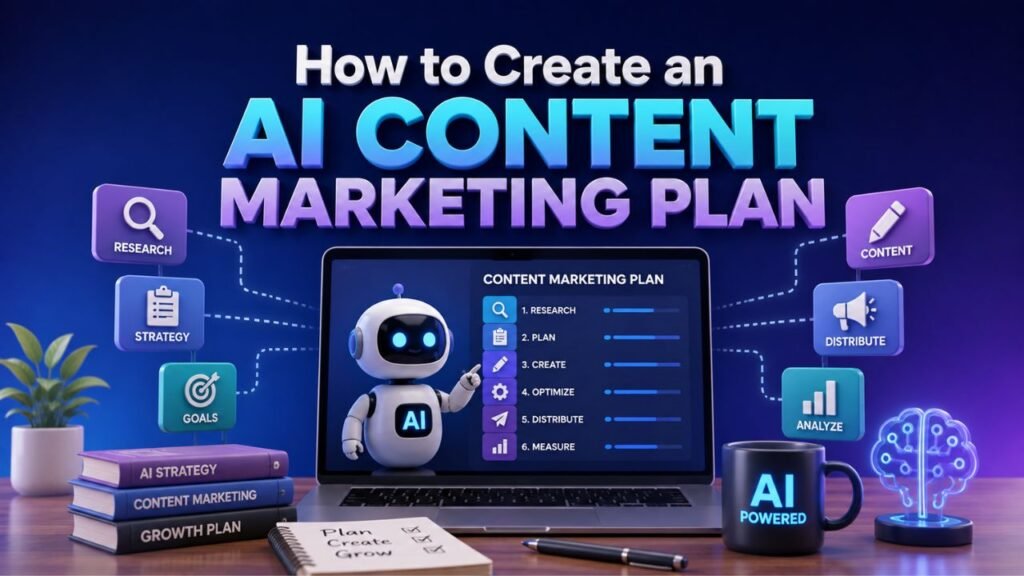
- You do not need to automate your entire marketing operation immediately.
- Start with a focused 30 day plan.
Week 1: Research and Strategy
- Define business objectives
- Identify your audience
- Analyze existing content
- Research customer questions
- Identify topic opportunities
- Analyze search intent
Week 2: Content Planning
- Build topic clusters
- Prioritize content
- Create content briefs
- Assign human reviewers
- Define internal linking opportunities
- Establish editorial standards
Week 3: Content Production
- Research sources
- Use AI for appropriate tasks
- Draft content
- Add expert insights
- Fact check
- Edit for brand voice
Week 4: Optimization and Distribution
- Complete SEO reviews
- Publish priority content
- Add internal links
- Repurpose content
- Distribute through relevant channels
- Establish performance benchmarks
Then continue improving based on results.
AI Content Marketing Best Practices
Keep these principles in your editorial process:
- Start with audience problems.
- Define search intent before writing.
- Use AI to improve efficiency.
- Keep strategic decisions under human control.
- Add original insights.
- Verify important claims.
- Use trustworthy sources.
- Demonstrate relevant expertise.
- Build content around topics rather than isolated keywords.
- Create useful internal links.
- Optimize for readers before search engines.
- Measure business outcomes.
- Update important content.
- Avoid mass producing low value pages.
- Make the content genuinely worth reading.
The most important principle is simple:
Use AI to make your marketing better, not merely bigger.
What Is the Future of AI Content Marketing?
AI will continue to change how marketers research, create, personalize, distribute, and evaluate content.
- But the strategic fundamentals are unlikely to disappear.
- Customers will still want accurate information.
- They will still want useful answers.
- They will still respond to relevant messaging.
- And businesses will still need credibility.
The biggest opportunity is therefore not to compete on how quickly you can generate content.
It is to combine AI’s ability to process information and accelerate repetitive work with human judgment, experience, creativity, and strategic thinking.
Google’s current guidance for AI search reinforces this direction: unique, valuable, non commodity content remains important, while established SEO practices continue to provide a foundation for visibility.
Conclusion
AI has made content production faster, but speed alone is not a competitive advantage.
Your real advantage comes from what you do with that additional capacity.
Use AI to accelerate research. Use it to organize ideas. Use it to support drafting, analysis, personalization, and repurposing. Then invest the time you save into the things that create genuine differentiation: expertise, originality, accuracy, strategic thinking, and customer understanding.
That is the foundation of effective AI Content Marketing.
If your current content operation is producing traffic but not enough qualified leads, the problem may not be how much content you publish. It may be your strategy, search intent alignment, topical coverage, conversion paths, or content quality.
A professional content and SEO audit can identify those gaps and show you where to focus next.
Frequently Asked Questions
What is AI Content Marketing?
AI Content Marketing is the use of artificial intelligence to support content research, planning, creation, optimization, personalization, distribution, and performance analysis. The strongest approach combines AI assistance with human expertise and editorial oversight.
Is AI Content Marketing good for SEO?
It can be. AI itself does not provide a special SEO advantage. Content still needs to be useful, accurate, relevant, original, and aligned with the user’s needs. Google states that AI generated content can perform well when it provides genuine value, while using automation primarily to manipulate rankings can violate its spam policies.
Can AI generated content rank on Google?
Yes, AI assisted or AI generated content can appear in Google Search. However, using AI does not guarantee rankings. The content needs to satisfy users and meet Google’s quality and spam guidelines.
Does Google penalize AI generated content?
Google does not say that content is automatically penalized simply because AI was involved. Its concern is whether content is helpful and valuable or whether automation is being used to manipulate search rankings or produce scaled low value content.
What are the best AI Content Marketing tools?
The best tool depends on your objective. Different tools can support writing, research, SEO analysis, content optimization, image creation, personalization, and analytics. Choose based on workflow requirements rather than simply selecting the tool with the most AI features.
How can marketers use AI without losing their brand voice?
Create clear editorial guidelines covering tone, terminology, positioning, audience, messaging, and prohibited language. Then use AI as an assistant while having human editors review important content before publication.
How do you measure AI Content Marketing ROI?
Measure both marketing and business outcomes. Track organic visibility, qualified traffic, engagement, leads, conversions, production time, content costs, and revenue influenced by content. The exact attribution model should match your customer journey.
Can AI replace content marketers?
AI can automate many repetitive content tasks, but effective marketing still requires strategy, audience understanding, creativity, judgment, expertise, and business context. The stronger model is usually human marketers using AI to increase their effectiveness.


