

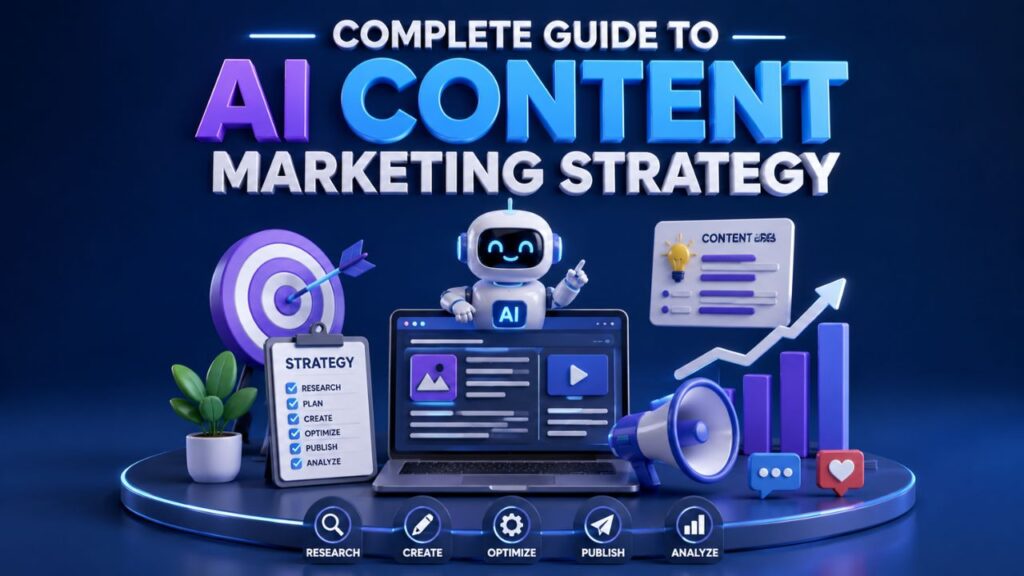
Artificial intelligence has transformed the way businesses approach content creation, audience engagement, and digital marketing. What once required extensive manual research, planning, and execution can now be streamlined with intelligent technologies that help marketers make faster and more informed decisions. As content competition continues to grow across industries, adopting an effective AI Content Marketing Strategy is becoming essential for brands that want to improve visibility, attract qualified traffic, and build stronger relationships with their audiences.
Modern consumers expect personalized experiences, relevant information, and timely interactions. Meeting these expectations consistently can be challenging without the support of advanced tools and automation. This is where artificial intelligence creates significant value. By analyzing large volumes of data, identifying trends, and automating repetitive tasks, AI enables marketers to focus on creating meaningful content that resonates with their target audience.
An AI Content Marketing Strategy goes beyond simply using AI writing tools. It involves integrating artificial intelligence into every stage of the content marketing process, including audience research, keyword analysis, content planning, optimization, distribution, and performance measurement. When implemented correctly, it can improve efficiency, strengthen SEO efforts, and deliver better business outcomes.
In this comprehensive guide, you will learn what an AI Content Marketing Strategy is, why it matters, how to build one effectively, and the best practices that can help you achieve sustainable growth in search engine rankings and audience engagement.
Table of Contents
What Is an AI Content Marketing Strategy?
An AI Content Marketing Strategy is a structured approach to planning, creating, optimizing, distributing, and analyzing content with the assistance of artificial intelligence technologies. The goal is to improve content quality, enhance efficiency, and make data driven decisions that contribute to better marketing performance.
Traditional content marketing often relies heavily on manual research and assumptions about audience behavior. While experience remains valuable, artificial intelligence introduces a new level of precision by analyzing real user data and identifying patterns that may not be immediately visible.
Understanding AI in Content Marketing
Artificial intelligence refers to technologies capable of processing information, learning from data, and performing tasks that typically require human intelligence. Within content marketing, AI can assist with:
- Content research
- Keyword analysis
- Topic discovery
- Audience segmentation
- Content creation
- Search engine optimization
- Content personalization
- Performance tracking
These capabilities help marketers create more targeted and relevant content while reducing the time spent on repetitive activities.
AI Content Marketing Versus Traditional Content Marketing
Although the core objective remains the same, there are important differences between traditional and AI powered content marketing.
Traditional content marketing often depends on manual research, historical data, and intuition. While effective, this approach can be time consuming and may not always capture emerging trends quickly.
An AI Content Marketing Strategy leverages advanced algorithms to process large datasets, identify opportunities, and provide actionable recommendations. This enables marketers to react faster to changing market conditions and consumer preferences.
For example, instead of spending hours researching trending topics, AI tools can analyze search behavior and highlight relevant content opportunities within minutes.
Key Components of an AI Content Marketing Strategy
Building an effective AI Content Marketing Strategy requires several interconnected components.
Audience Intelligence
Understanding your audience is the foundation of successful content marketing. AI can analyze demographic information, browsing behavior, engagement patterns, and purchase history to create detailed audience profiles.
These insights allow marketers to produce content that addresses specific interests, challenges, and needs.
Content Planning
Content planning becomes significantly more efficient when AI assists with topic selection, keyword clustering, and trend analysis.
AI powered systems can identify:
- High demand topics
- Emerging industry trends
- Content gaps
- Seasonal opportunities
- User intent patterns
This information helps marketers create content calendars that align with audience demand and business goals.
Content Creation
Artificial intelligence can support content creation by generating outlines, suggesting headings, drafting sections, and improving readability.
However, successful marketers understand that human oversight remains essential. AI should enhance creativity rather than replace it. Human expertise ensures accuracy, authenticity, and brand consistency.
Content Optimization
Search engine optimization is one of the most valuable applications of artificial intelligence.
AI content optimization can help with:
- Keyword placement
- Semantic relevance
- Internal linking recommendations
- Readability improvements
- Metadata optimization
- Content structure enhancements
These improvements contribute to stronger search visibility and a better user experience.
Content Distribution
Creating excellent content is only part of the equation. Distribution plays a critical role in reaching the intended audience.
Artificial intelligence can identify the most effective channels, publishing times, and promotional opportunities. This increases the likelihood of content reaching the right users at the right moment.
Performance Measurement
One of the strongest advantages of an AI Content Marketing Strategy is the ability to measure performance accurately.
AI analytics platforms can track:
- Organic traffic growth
- Keyword rankings
- User engagement
- Conversion rates
- Lead generation
- Revenue attribution
These insights help marketers continuously refine their strategies and improve results over time.
Why Businesses Are Adopting AI Content Marketing?
The rapid adoption of artificial intelligence in marketing is driven by several factors.
- First, content competition continues to increase across virtually every industry. Businesses need efficient ways to produce high quality content without sacrificing quality.
- Second, personalization has become a major expectation among consumers. AI enables marketers to deliver tailored experiences at scale.
- Third, search engines increasingly prioritize relevance and user satisfaction. An effective AI Content Marketing Strategy helps businesses align content with search intent and user expectations.
- Finally, AI improves operational efficiency by automating repetitive tasks and providing actionable insights that support smarter decision making.
Organizations that embrace artificial intelligence strategically are often better positioned to adapt to market changes, improve content performance, and achieve long term growth.
Why AI Content Marketing Strategy Matters in 2026?
Content marketing continues to evolve at a rapid pace. Search engines have become more sophisticated, audience expectations have increased, and competition for online visibility is stronger than ever. In this environment, businesses that rely solely on traditional content workflows may struggle to keep up with changing demands.
An effective AI Content Marketing Strategy helps organizations adapt to these changes by combining data driven insights with scalable content operations. Rather than replacing human expertise, artificial intelligence enhances decision making and allows marketers to focus on creating valuable experiences for their audiences.
The Growing Competition for Online Visibility
Every day, millions of new pieces of content are published across websites, blogs, social media platforms, and digital publications. As a result, earning attention from potential customers has become increasingly challenging.
Search engines aim to provide users with the most relevant and useful information available. This means content creators must produce comprehensive, well optimized, and user focused content that stands out from competitors.
An AI Content Marketing Strategy helps identify underserved topics, uncover keyword opportunities, and reveal content gaps that can be leveraged to gain a competitive advantage.
Increasing Demand for Personalized Experiences
Modern consumers expect brands to understand their needs and provide relevant content throughout the customer journey. Generic messaging often fails to capture attention because users are looking for information that addresses their specific challenges and goals.
Artificial intelligence makes personalization more achievable by analyzing audience behavior and identifying patterns that influence engagement.
With AI powered insights, marketers can:
- Deliver personalized content recommendations
- Create audience specific messaging
- Improve customer engagement
- Increase conversion opportunities
- Enhance user satisfaction
As personalization becomes more important, businesses that implement a strong AI Content Marketing Strategy can build stronger relationships with their audiences.
Faster Content Production Requirements
The demand for fresh and relevant content continues to grow. Businesses must consistently publish high quality articles, videos, guides, emails, and social media content to remain visible.
Producing this volume of content manually can create bottlenecks and strain resources.
Artificial intelligence helps streamline many stages of content production, including:
- Topic research
- Outline creation
- Content drafting
- Optimization recommendations
- Performance analysis
This allows marketing teams to work more efficiently while maintaining quality standards.
Data Driven Decision Making
Successful content marketing depends on understanding what works and what does not. However, analyzing large amounts of marketing data manually can be difficult and time consuming.
An AI Content Marketing Strategy provides access to deeper insights by processing large datasets and identifying meaningful trends.
These insights can help marketers:
- Understand audience preferences
- Discover emerging content opportunities
- Evaluate campaign performance
- Improve content planning
- Predict future trends
Instead of relying solely on assumptions, marketers can make informed decisions based on real data.
The Rise of Search Intent Optimization
Search engines are increasingly focused on understanding user intent rather than simply matching keywords.
When someone performs a search, they may be looking to learn something, compare options, solve a problem, or make a purchase. Content that aligns with these intentions tends to perform better in search results.
Artificial intelligence can help marketers identify intent patterns and create content that satisfies user expectations more effectively.
This makes AI Content Marketing Strategy an important component of modern SEO because it helps ensure content matches what users actually want to find.
Enhanced Content Quality Through AI Assistance
Contrary to common misconceptions, artificial intelligence is not only about producing content faster. It can also contribute to higher quality content when used correctly.
AI tools can assist with:
- Improving readability
- Enhancing content structure
- Identifying missing subtopics
- Suggesting semantic keywords
- Detecting content gaps
- Optimizing content flow
Combined with human expertise, these capabilities create more comprehensive and valuable content experiences.
Better Resource Allocation
Many marketing teams operate with limited budgets, time, and personnel. Artificial intelligence helps maximize available resources by automating repetitive processes and reducing manual workloads.
This enables teams to spend more time on strategic activities such as:
- Brand development
- Creative storytelling
- Customer engagement
- Content innovation
- Long term planning
As a result, businesses can achieve greater efficiency without sacrificing quality.
Supporting Long Term SEO Growth
Search engine optimization is not a one time effort. It requires ongoing content creation, optimization, updates, and performance monitoring.
An AI Content Marketing Strategy supports sustainable SEO growth by helping marketers:
- Identify new keyword opportunities
- Build topical authority
- Strengthen internal linking structures
- Update outdated content
- Monitor ranking changes
- Analyze competitor performance
These ongoing improvements contribute to stronger organic visibility over time.
Aligning With Future Marketing Trends
Artificial intelligence is expected to play an even larger role in digital marketing in the coming years. Businesses that begin integrating AI into their content processes today will be better prepared for future developments.
Whether it involves predictive analytics, advanced personalization, voice search optimization, or automated content workflows, artificial intelligence is becoming an essential component of modern marketing strategies.
Organizations that embrace these technologies strategically can position themselves for long term success in an increasingly competitive digital landscape.
Benefits of Using an AI Content Marketing Strategy
Businesses invest significant time and resources into content marketing because it helps attract potential customers, build trust, and generate long term organic traffic. However, achieving consistent results can be challenging when content planning, creation, optimization, and analysis are handled entirely through manual processes.
This is where an AI Content Marketing Strategy delivers measurable advantages. By leveraging artificial intelligence across multiple stages of content marketing, businesses can improve efficiency, make smarter decisions, and create content that better serves their audience.
Let’s explore the most important benefits of implementing an AI driven marketing approach.
Improved Content Research
One of the most time consuming aspects of content marketing is research. Before creating content, marketers must understand audience interests, identify relevant topics, analyze competitors, and discover valuable keywords.
Artificial intelligence significantly accelerates this process by analyzing vast amounts of data in a fraction of the time required by manual research methods.
AI powered content marketing tools can help identify:
- Trending topics
- Popular search queries
- Emerging industry discussions
- Competitor content gaps
- User pain points
- Audience interests
This enables marketers to focus on content opportunities that have the highest potential impact.
Discovering Content Opportunities Faster
Finding topics that resonate with readers is critical for content success. AI tools can evaluate search patterns and content performance data to uncover opportunities that may otherwise go unnoticed.
Instead of relying on guesswork, marketers can create content backed by real user demand.
This makes an AI Content Marketing Strategy more efficient and results driven.
Faster Content Creation
Content production often involves multiple stages, including ideation, outlining, drafting, editing, and optimization. Completing these tasks manually can limit how much content a team can produce.
Artificial intelligence helps streamline many of these activities without compromising strategic quality.
AI can assist with:
- Generating content ideas
- Creating detailed outlines
- Producing draft content
- Suggesting headings
- Improving readability
- Recommending content structures
As a result, content teams can focus more on refining insights, adding expertise, and enhancing audience value.
Scaling Content Production
Businesses that publish content consistently often experience stronger search visibility and audience engagement.
An AI Content Marketing Strategy makes it easier to scale content production while maintaining workflow efficiency.
This becomes particularly valuable for organizations managing:
- Blogs
- Landing pages
- Email campaigns
- Social media content
- Product descriptions
- Knowledge bases
Enhanced Audience Targeting
Successful content marketing depends on reaching the right audience with the right message.
Artificial intelligence excels at analyzing audience behavior and identifying meaningful patterns that can improve targeting accuracy.
AI systems can evaluate:
- Browsing behavior
- Engagement history
- Purchase patterns
- Demographic information
- Search behavior
- Content preferences
These insights help marketers create highly relevant content experiences.
Better Understanding of Customer Intent
Understanding why users search for specific information is just as important as understanding what they search for.
AI can help identify different types of intent, including:
- Informational intent
- Commercial investigation intent
- Transactional intent
- Navigational intent
When content aligns with user intent, it is more likely to attract qualified traffic and generate meaningful engagement.
Better SEO Performance
Search engine optimization remains one of the most valuable benefits of implementing an AI Content Marketing Strategy.
Modern SEO requires more than simply inserting keywords into content. Search engines evaluate content quality, relevance, expertise, structure, user experience, and topical coverage.
Artificial intelligence helps marketers optimize content more effectively by providing actionable recommendations.
Improved Keyword Research
AI powered keyword research tools can identify:
- High value keywords
- Long tail keyword opportunities
- Related search queries
- Semantic keywords
- Question based keywords
- Content gaps
This helps create content that aligns with real search demand.
Stronger Topical Authority
Search engines increasingly reward websites that demonstrate expertise across an entire topic rather than focusing on isolated keywords.
AI tools can assist with:
- Topic clustering
- Content mapping
- Internal linking recommendations
- Entity optimization
- Semantic relevance
These strategies contribute to stronger topical authority and improved search visibility.
Enhanced On Page Optimization
AI content optimization tools can improve:
- Headings
- Meta descriptions
- Keyword placement
- Content structure
- Readability
- Internal links
Together, these improvements create a better experience for both users and search engines.
Content Personalization at Scale
Personalization has become a major factor in customer engagement.
Consumers increasingly expect brands to provide relevant content that reflects their interests, needs, and stage in the buying journey.
Without automation, delivering personalized experiences at scale can be difficult.
An AI Content Marketing Strategy makes personalization more achievable through data analysis and automation.
Creating More Relevant Experiences
Artificial intelligence can help tailor content based on:
- User behavior
- Purchase history
- Location
- Industry
- Interests
- Engagement patterns
Personalized content often leads to:
- Higher engagement rates
- Longer session durations
- Improved customer satisfaction
- Better conversion performance
Increased Marketing Efficiency
Marketing teams frequently face resource limitations. Time spent on repetitive tasks can reduce the amount of energy available for strategic initiatives.
Artificial intelligence helps improve efficiency by automating many routine activities.
Examples include:
- Content categorization
- Keyword analysis
- Performance monitoring
- Content recommendations
- Reporting
- Audience segmentation
This allows marketers to allocate more resources toward creativity, strategy, and relationship building.
Reducing Manual Workloads
Rather than replacing marketers, AI acts as a productivity enhancer.
By automating repetitive processes, teams can focus on:
- Creative storytelling
- Strategic planning
- Brand positioning
- Customer engagement
- Campaign innovation
This balance between automation and human expertise often produces stronger results.
Improved Content Consistency
Maintaining consistency across a growing content library can be challenging, especially for larger organizations.
Artificial intelligence helps ensure consistency in areas such as:
- Content structure
- Tone of voice
- Keyword targeting
- Formatting standards
- Publishing schedules
Consistent content experiences strengthen brand identity and improve audience trust.
Better Data Analysis and Reporting
One of the greatest strengths of artificial intelligence is its ability to process large datasets quickly and accurately.
Marketers often collect data from multiple sources, including:
- Search engines
- Analytics platforms
- Social media channels
- CRM systems
- Email marketing platforms
Analyzing this information manually can be overwhelming.
AI powered analytics tools simplify this process by identifying trends, patterns, and actionable insights.
Real Time Performance Insights
An AI Content Marketing Strategy enables marketers to monitor:
- Organic traffic trends
- Ranking movements
- User engagement metrics
- Conversion rates
- Content performance
- Audience behavior
These insights support continuous improvement and informed decision making.
Higher Return on Investment
Every marketing initiative is ultimately evaluated based on results.
When implemented effectively, an AI Content Marketing Strategy can improve return on investment by helping businesses:
- Create more targeted content
- Improve SEO performance
- Increase engagement
- Enhance personalization
- Reduce operational inefficiencies
- Generate more qualified leads
The combination of improved effectiveness and greater efficiency often leads to stronger overall marketing performance.
Competitive Advantage in Content Marketing
Businesses that leverage artificial intelligence strategically can gain advantages over competitors who rely solely on traditional processes.
AI helps organizations:
- React faster to market changes
- Identify new opportunities
- Produce content efficiently
- Optimize performance continuously
- Understand customer needs more deeply
As content competition continues to increase, these advantages become increasingly valuable.
How AI Is Transforming the Content Marketing Process
The content marketing landscape has changed dramatically over the past few years. Businesses are no longer relying solely on manual research, traditional brainstorming sessions, and intuition to create successful content campaigns. Artificial intelligence is reshaping every stage of the content marketing workflow, helping marketers make smarter decisions and execute strategies more efficiently.
An effective AI Content Marketing Strategy integrates artificial intelligence throughout the entire content lifecycle, from initial topic research to performance measurement. This approach enables businesses to create more relevant content, improve operational efficiency, and deliver better experiences to their audiences.
Let’s examine how AI is transforming the content marketing process from start to finish.
AI for Topic Discovery
Finding the right topics is the foundation of successful content marketing. Even the most well written content can struggle to perform if it addresses subjects that users are not actively searching for.
Traditionally, marketers spent hours researching industry trends, analyzing competitors, and brainstorming ideas. Artificial intelligence significantly improves this process by identifying opportunities based on real search behavior and audience interests.
Identifying Trending Topics
AI powered systems can analyze:
- Search engine queries
- Industry publications
- Social media conversations
- Consumer behavior patterns
- Emerging market trends
This allows marketers to identify content opportunities before they become highly competitive.
By recognizing emerging trends early, businesses can establish authority and attract valuable traffic ahead of competitors.
Discovering Audience Pain Points
Successful content solves problems.
Artificial intelligence helps uncover common questions, concerns, and challenges faced by target audiences. These insights make it easier to create content that directly addresses user needs.
When an AI Content Marketing Strategy focuses on solving real problems, content naturally becomes more engaging and useful.
AI for Keyword Research
Keyword research remains one of the most important aspects of search engine optimization. However, modern keyword research goes far beyond identifying high volume search terms.
Artificial intelligence helps marketers uncover deeper insights about user intent, semantic relevance, and content opportunities.
Finding High Value Keywords
AI powered keyword research tools can analyze:
- Search volume
- Keyword difficulty
- User intent
- Seasonal trends
- Ranking opportunities
- Competitor performance
This enables marketers to prioritize keywords that offer the greatest potential return.
Identifying Long Tail Opportunities
Long tail keywords often attract highly targeted visitors who are closer to making a decision.
Artificial intelligence can uncover valuable long tail opportunities that might be overlooked through manual research.
Examples include:
- Question based searches
- Industry specific queries
- Problem solving searches
- Location based searches
- Product comparison terms
These keywords often support stronger conversion rates because they align closely with user intent.
Building Topic Clusters
Search engines increasingly evaluate topical authority rather than individual keywords alone.
AI can help organize keywords into topic clusters that support a comprehensive content strategy.
This approach helps businesses:
- Strengthen semantic relevance
- Improve internal linking
- Increase topical authority
- Enhance user experience
As a result, the entire website benefits from stronger SEO performance.
AI for Content Brief Creation
Creating detailed content briefs is often a time intensive task. Writers must gather information about target keywords, competitor content, audience intent, and content structure before drafting begins.
Artificial intelligence streamlines this process by generating comprehensive content recommendations.
Building Smarter Content Frameworks
AI generated content briefs can include:
- Primary keywords
- Secondary keywords
- Recommended headings
- Common user questions
- Competitor insights
- Content gaps
- Search intent analysis
This creates a strong foundation for producing content that satisfies both users and search engines.
Improving Content Consistency
Content briefs help maintain consistency across multiple writers and campaigns.
When integrated into an AI Content Marketing Strategy, AI generated briefs ensure that content aligns with strategic objectives while maintaining quality standards.
AI for Content Creation
Content creation is often the most discussed application of artificial intelligence in marketing.
AI writing technologies can support writers by accelerating the drafting process and providing creative assistance throughout content development.
Accelerating Content Production
Artificial intelligence can help generate:
- Blog outlines
- Draft articles
- Product descriptions
- Email campaigns
- Social media captions
- Landing page copy
This reduces the time required to move from concept to publication.
Supporting Human Creativity
Despite advancements in AI content generation, human expertise remains essential.
Writers provide:
- Industry knowledge
- Personal insights
- Strategic thinking
- Brand voice
- Emotional intelligence
The most successful AI Content Marketing Strategy combines artificial intelligence with human creativity rather than relying exclusively on automation.
Maintaining Content Quality
AI generated content should always undergo human review.
This ensures:
- Accuracy
- Originality
- Relevance
- Brand consistency
- User value
Human oversight remains critical for building trust and maintaining content quality.
AI for Content Optimization
Creating content is only one part of achieving search visibility. Content must also be optimized to meet search engine expectations and user needs.
Artificial intelligence helps identify opportunities for improvement before content is published.
Enhancing Semantic Relevance
Search engines have become increasingly effective at understanding context and relationships between topics.
AI optimization tools can recommend:
- Related keywords
- Supporting entities
- Semantic phrases
- Topic expansions
- Missing subtopics
These recommendations help create more comprehensive content.
Improving Readability
User experience is an important ranking factor.
Artificial intelligence can evaluate:
- Sentence structure
- Reading level
- Paragraph length
- Content flow
- Engagement potential
Improved readability often results in better user engagement and stronger SEO performance.
Strengthening Internal Linking
Internal links help search engines understand website structure while guiding users to relevant information.
AI can identify strategic internal linking opportunities that support:
- Topic clusters
- Content discovery
- Authority distribution
- User navigation
These improvements contribute to stronger overall website performance.
AI for Content Distribution
Publishing great content does not guarantee visibility. Effective distribution is necessary to ensure content reaches the intended audience.
Artificial intelligence helps marketers maximize content reach through smarter distribution strategies.
Optimizing Publishing Schedules
AI can analyze audience behavior to determine:
- Best publishing times
- Optimal posting frequency
- Channel performance
- Engagement patterns
This increases the likelihood of content receiving attention when audiences are most active.
Multi Channel Content Distribution
An AI Content Marketing Strategy often involves distributing content across multiple channels, including:
- Blogs
- Social media
- Email marketing
- Newsletters
- Community platforms
- Industry publications
Artificial intelligence can help prioritize channels based on expected performance and audience engagement.
AI for Analytics and Performance Tracking
Data analysis is one of the areas where artificial intelligence provides the greatest value.
Modern marketing campaigns generate enormous amounts of data. AI helps transform this information into actionable insights.
Monitoring Content Performance
AI powered analytics tools can track:
- Organic traffic
- Keyword rankings
- Click through rates
- Bounce rates
- Engagement metrics
- Conversion performance
These insights help marketers understand which content is delivering results and which areas require improvement.
Predicting Future Trends
One of the most powerful capabilities of artificial intelligence is predictive analysis.
AI can identify patterns that suggest future opportunities or challenges.
This helps marketers:
- Anticipate audience needs
- Prepare future content
- Allocate resources effectively
- Improve strategic planning
Businesses that leverage predictive insights often gain an advantage over competitors who react only after trends emerge.
AI and Content Personalization
Personalization has become a key component of successful digital marketing.
Artificial intelligence enables businesses to deliver tailored experiences based on individual user behavior and preferences.
Creating Personalized Content Journeys
AI can recommend content based on:
- Previous interactions
- Search history
- Industry interests
- Purchase behavior
- Engagement patterns
These personalized experiences often result in higher engagement and stronger customer relationships.
Improving Conversion Opportunities
When users receive content that aligns closely with their interests and needs, they are more likely to take meaningful actions.
This may include:
- Subscribing to newsletters
- Downloading resources
- Requesting consultations
- Making purchases
Personalization therefore plays an important role in maximizing content marketing results.
Building an Effective AI Content Marketing Strategy
Understanding the benefits of artificial intelligence is important, but achieving meaningful results requires a structured implementation plan. Simply using AI tools does not automatically lead to better content performance. Success comes from integrating artificial intelligence into a well defined content marketing framework that aligns with business objectives and audience needs.
An effective AI Content Marketing Strategy combines technology, data, human expertise, and continuous optimization. When these elements work together, businesses can create content that attracts qualified traffic, improves engagement, and drives long term growth.
The following step by step framework can help you build a scalable and results driven strategy.
Step 1: Define Clear Content Marketing Goals
Every successful strategy begins with clear objectives.
Before implementing artificial intelligence into your content workflow, determine what you want to achieve. Without defined goals, it becomes difficult to measure success or allocate resources effectively.
Common content marketing goals include:
- Increasing organic traffic
- Improving keyword rankings
- Generating qualified leads
- Building brand awareness
- Growing email subscribers
- Increasing customer engagement
- Improving conversion rates
- Establishing industry authority
Your goals should influence every aspect of your AI Content Marketing Strategy.
Align Content Goals With Business Objectives
Content marketing should support broader business outcomes.
For example:
| Business Objective | Content Marketing Goal |
| Increase sales | Generate qualified leads |
| Build brand recognition | Expand content reach |
| Improve customer retention | Publish educational resources |
| Enter new markets | Create audience specific content |
When content goals support business objectives, it becomes easier to demonstrate return on investment.
Step 2: Understand Your Target Audience
Even the most advanced AI tools cannot compensate for a poor understanding of your audience.
Successful content marketing starts with knowing who you are trying to reach.
Develop Detailed Audience Profiles
Audience profiles should include:
- Demographics
- Industry information
- Professional roles
- Challenges and pain points
- Goals and motivations
- Buying behaviors
- Content preferences
Artificial intelligence can help analyze customer data and uncover valuable audience insights that support content planning.
Map the Customer Journey
Different users require different types of content depending on where they are in the buying process.
The customer journey typically includes:
Awareness Stage
Users are identifying a problem or seeking information.
Content examples:
- Educational blog posts
- Industry guides
- How to articles
- Explainer content
Consideration Stage
Users are evaluating possible solutions.
Content examples:
- Comparison articles
- Expert insights
- Case based discussions
- Product evaluations
Decision Stage
Users are ready to take action.
Content examples:
- Product pages
- Service pages
- Testimonials
- Consultation offers
An AI Content Marketing Strategy should address all stages of the customer journey.
Step 3: Conduct AI Powered Keyword Research
Keyword research remains a foundational element of SEO success.
However, modern keyword research focuses on understanding topics and search intent rather than simply targeting individual phrases.
Identify Your Primary Keyword
For this article, the primary keyword is:
AI Content Marketing Strategy
This keyword should appear naturally throughout the content while maintaining readability and user value.
Discover Supporting Keywords
AI powered keyword research tools can identify relevant supporting phrases such as:
- AI content marketing
- AI content creation
- AI powered content marketing
- AI marketing strategy
- AI content optimization
- AI content planning
- AI for SEO
- Content marketing automation
- AI driven marketing
- AI content tools
These related terms strengthen topical relevance and semantic SEO.
Focus on Search Intent
Search intent plays a critical role in modern SEO.
Before creating content, determine whether users are seeking:
- Information
- Comparisons
- Solutions
- Products
- Services
Aligning content with search intent improves user satisfaction and search performance.
Analyze Competitor Content
Artificial intelligence can evaluate competitor pages to identify:
- Missing topics
- Content gaps
- Keyword opportunities
- Weaknesses in existing content
This analysis helps create more comprehensive and competitive content assets.
Step 4: Build Topic Clusters and Content Pillars
Google increasingly rewards websites that demonstrate expertise across an entire subject area.
Rather than publishing isolated articles, focus on building interconnected content ecosystems.
Create a Pillar Content Strategy
A pillar page serves as the central resource for a broad topic.
For example:
Pillar Topic: AI Content Marketing Strategy
Supporting cluster topics may include:
- AI Content Creation Tools
- AI SEO Optimization Techniques
- AI Content Personalization
- AI Marketing Automation
- AI Keyword Research
- AI Content Analytics
- AI Content Distribution Strategies
- Future of AI in Marketing
This structure strengthens topical authority and improves internal linking opportunities.
Benefits of Topic Clusters
Topic clusters help:
- Improve search visibility
- Increase topical authority
- Enhance user navigation
- Support internal linking
- Improve crawl efficiency
A strong cluster model is often a key component of a successful AI Content Marketing Strategy.
Step 5: Create a Strategic Content Calendar
Consistency is essential for long term content marketing success.
Publishing content sporadically can limit growth and reduce audience engagement.
A content calendar provides structure and ensures ongoing content production.
Plan Content by Priority
Organize content into categories such as:
High Priority Content
- Core service pages
- Pillar content
- Revenue focused articles
Medium Priority Content
- Supporting cluster articles
- Industry trend content
- Educational resources
Low Priority Content
- Seasonal updates
- News commentary
- Experimental content
This prioritization helps allocate resources efficiently.
Use AI for Content Planning
Artificial intelligence can assist with:
- Content scheduling
- Trend forecasting
- Topic recommendations
- Publishing frequency analysis
These insights help create a more strategic publishing roadmap.
Step 6: Create High Quality Content With Human Oversight
Artificial intelligence can significantly accelerate content production, but human expertise remains essential.
Google rewards content that demonstrates experience, expertise, authoritativeness, and trustworthiness.
Prioritize User Value
Every piece of content should answer questions, solve problems, or provide meaningful insights.
Before publishing, ask:
- Does this content satisfy user intent?
- Is the information accurate?
- Does it offer unique value?
- Is it easy to understand?
- Would readers find it genuinely useful?
If the answer is yes, the content is more likely to perform well.
Maintain a Consistent Brand Voice
AI generated content can sometimes sound generic.
Human editors should ensure:
- Brand consistency
- Clear messaging
- Authentic communication
- Natural language flow
This helps create stronger connections with readers.
Fact Check All Content
Accuracy is essential for trust and credibility.
Always verify:
- Statistics
- Industry data
- Research findings
- Expert statements
- Technical information
Fact checked content strengthens user confidence and supports long term SEO performance.
Step 7: Optimize Content for Search Engines
Publishing content without optimization limits its visibility.
Every article should be optimized to improve discoverability while maintaining a positive user experience.
On Page SEO Best Practices
Focus on:
- Keyword placement
- Optimized headings
- Internal linking
- Descriptive URLs
- Meta descriptions
- Image optimization
- Structured content formatting
Optimize for Semantic SEO
Search engines increasingly evaluate contextual relevance.
Include:
- Related entities
- Supporting concepts
- Frequently asked questions
- Semantic keywords
- Topic specific terminology
This helps search engines understand content depth and relevance.
Strengthen Internal Linking
Internal links help distribute authority throughout your website.
Link related content whenever appropriate to:
- Improve user navigation
- Increase page views
- Strengthen topical authority
- Support indexing
A robust internal linking strategy is an important component of any AI Content Marketing Strategy.
Step 8: Measure Performance and Continuously Improve
Content marketing is an ongoing process rather than a one time project.
Regular performance analysis helps identify opportunities for improvement.
Monitor Key Metrics
Track:
- Organic traffic
- Keyword rankings
- Click through rates
- Bounce rates
- Average engagement time
- Conversions
- Lead generation
These metrics provide valuable insights into content effectiveness.
Update Existing Content
Content freshness remains important for SEO.
Review older content regularly to:
- Add new information
- Improve accuracy
- Expand topic coverage
- Update statistics
- Enhance optimization
Updated content often performs better than continuously publishing new content alone.
Use AI for Predictive Insights
Artificial intelligence can help forecast:
- Emerging trends
- Keyword opportunities
- Audience interests
- Content performance patterns
These insights support proactive decision making and future content planning.
Best AI Tools for Content Marketing Strategy
A successful AI Content Marketing Strategy depends not only on processes and planning but also on selecting the right tools. Artificial intelligence platforms can help marketers streamline research, content creation, optimization, personalization, distribution, and analytics. However, not every tool serves the same purpose.
The most effective approach is to build a technology stack that supports your content goals while complementing human expertise. Instead of relying on a single platform, many organizations combine multiple AI solutions to create a comprehensive content marketing ecosystem.
Let’s explore the major categories of AI tools and how they contribute to a high performing content marketing strategy.
AI Content Writing Tools
Content creation is one of the most popular applications of artificial intelligence. AI writing tools can assist with brainstorming ideas, generating outlines, drafting content, improving readability, and enhancing productivity.
How AI Writing Tools Support Content Creation
These tools can help marketers:
- Generate article outlines
- Create content drafts
- Develop blog introductions
- Write social media content
- Produce email copy
- Generate content ideas
- Improve writing efficiency
When integrated into an AI Content Marketing Strategy, writing tools help reduce production time while allowing marketers to focus on quality, strategy, and audience engagement.
Best Practices for Using AI Writing Tools
To maximize results:
- Use AI for research and drafting support
- Add human expertise and insights
- Verify all facts and statistics
- Edit for brand voice consistency
- Optimize content for user intent
The strongest content usually combines AI assistance with human creativity and subject matter expertise.
AI Keyword Research Tools
Keyword research remains a foundational aspect of content marketing and SEO.
AI powered keyword research tools help identify search opportunities by analyzing large amounts of search data quickly and accurately.
Key Features of AI Keyword Research Tools
These tools often provide:
- Keyword suggestions
- Search volume estimates
- Keyword difficulty scores
- User intent analysis
- Topic clustering recommendations
- Competitor keyword insights
- Long tail keyword opportunities
Benefits for Content Marketing
Using AI for keyword research helps marketers:
- Discover untapped opportunities
- Understand audience interests
- Build stronger topic clusters
- Improve content relevance
- Support long term SEO growth
A data driven keyword strategy ensures content aligns with what users are actively searching for.
AI Content Planning Tools
Content planning is critical for maintaining consistency and building topical authority.
AI powered planning tools help marketers organize content strategies more effectively by analyzing trends, audience behavior, and search demand.
How AI Improves Content Planning
Artificial intelligence can assist with:
- Topic discovery
- Editorial calendar creation
- Trend forecasting
- Content gap analysis
- Competitor monitoring
- Audience research
These insights help teams prioritize high impact content opportunities.
Building a Strategic Publishing Roadmap
An AI Content Marketing Strategy benefits from structured planning because it reduces guesswork and ensures content efforts align with business objectives.
Well planned content calendars often lead to:
- Better consistency
- Improved resource allocation
- Stronger topic coverage
- Enhanced audience engagement
AI SEO Optimization Tools
Search engine optimization has become increasingly sophisticated. Modern SEO requires content that satisfies user intent, demonstrates topical depth, and provides exceptional value.
AI powered SEO tools help marketers optimize content for both users and search engines.
Common SEO Optimization Features
These platforms often provide recommendations related to:
- Keyword placement
- Semantic keywords
- Content structure
- Readability improvements
- Internal linking
- Metadata optimization
- Competitor benchmarking
Supporting Semantic SEO
Search engines evaluate relationships between concepts rather than simply counting keywords.
AI optimization tools can identify:
- Related entities
- Supporting subtopics
- Missing concepts
- Contextual relevance opportunities
These recommendations help strengthen topical authority and improve search visibility.
AI Content Personalization Tools
Personalization plays an increasingly important role in digital marketing success.
Consumers expect content experiences that reflect their interests, behaviors, and preferences.
AI personalization tools make this possible at scale.
Personalization Capabilities
These systems can help deliver:
- Personalized content recommendations
- Dynamic website experiences
- Targeted email campaigns
- Audience segmentation
- Behavioral targeting
- Customer journey customization
Improving User Engagement
Relevant content often results in:
- Longer session durations
- Higher engagement rates
- Increased customer satisfaction
- Better conversion performance
For many businesses, personalization has become an essential component of an effective AI Content Marketing Strategy.
AI Content Distribution Tools
Even exceptional content requires effective distribution to achieve meaningful results.
AI powered distribution tools help marketers maximize visibility by identifying the best channels and timing for content promotion.
Distribution Functions
These tools may assist with:
- Social media scheduling
- Audience targeting
- Content promotion
- Channel performance analysis
- Publishing recommendations
- Engagement tracking
Reaching the Right Audience
Artificial intelligence helps determine where audiences are most active and which channels generate the strongest engagement.
This improves content reach while optimizing marketing resources.
AI Analytics and Reporting Tools
Data driven decision making is one of the greatest advantages of artificial intelligence.
AI analytics tools help marketers understand content performance and identify opportunities for improvement.
What AI Analytics Can Measure
Common metrics include:
- Organic traffic
- Keyword rankings
- Engagement metrics
- User behavior
- Conversion rates
- Lead generation
- Revenue attribution
Turning Data Into Actionable Insights
Rather than simply presenting raw data, AI systems can identify patterns and recommend actions.
This helps marketers:
- Improve content performance
- Optimize campaigns
- Refine targeting strategies
- Identify growth opportunities
Analytics play a critical role in continuous improvement and long term success.
AI Competitor Analysis Tools
Understanding competitor strategies can reveal valuable opportunities.
AI powered competitor analysis tools evaluate competing websites and content assets to uncover strengths, weaknesses, and gaps.
Insights Provided by Competitor Analysis Tools
These platforms can identify:
- Ranking keywords
- Content gaps
- Backlink opportunities
- Topic coverage weaknesses
- Traffic trends
- Content performance benchmarks
Gaining a Competitive Advantage
Businesses can use these insights to:
- Create more comprehensive content
- Target overlooked keywords
- Improve topical authority
- Differentiate content strategies
Competitive intelligence supports smarter content planning and stronger SEO outcomes.
AI Workflow Automation Tools
Managing content operations often involves repetitive tasks that consume valuable time.
AI workflow automation tools help streamline content marketing processes.
Common Automation Applications
Examples include:
- Content approvals
- Task assignments
- Publishing workflows
- Reporting processes
- Performance monitoring
- Content updates
Increasing Operational Efficiency
Automation helps teams:
- Save time
- Reduce manual work
- Improve consistency
- Enhance productivity
- Scale content operations
This allows marketers to focus on strategic and creative activities.
How to Choose the Right AI Tools
With countless AI solutions available, selecting the right tools can be challenging.
Before investing in any platform, consider the following factors.
Define Your Goals
Choose tools that align with your objectives.
Examples include:
- SEO improvement
- Content creation
- Personalization
- Analytics
- Automation
Your goals should determine your technology requirements.
Evaluate Integration Capabilities
The best tools work seamlessly with existing marketing systems.
Look for solutions that integrate with:
- Content management systems
- Analytics platforms
- Customer relationship management software
- Email marketing tools
- Social media platforms
Prioritize Usability
Complex tools can create adoption challenges.
Select platforms that offer:
- User friendly interfaces
- Reliable support
- Clear reporting
- Scalable functionality
Ease of use often contributes significantly to long term success.
Consider Human Oversight Requirements
Artificial intelligence should support decision making rather than replace it.
The ideal AI Content Marketing Strategy combines automation with human expertise to ensure quality, accuracy, and authenticity.
AI Content Marketing Strategy for SEO
Search engine optimization and content marketing have always been closely connected. However, modern SEO is no longer about targeting a few keywords and hoping for rankings. Search engines now evaluate content quality, user satisfaction, topical authority, expertise, relevance, and overall usefulness.
This shift has made artificial intelligence an increasingly valuable asset for marketers. An effective AI Content Marketing Strategy helps businesses create content that aligns with search intent, covers topics comprehensively, and delivers a better user experience.
When implemented correctly, AI can support every major SEO objective, from keyword research and content optimization to internal linking and performance analysis.
Understanding the Relationship Between AI and SEO
Artificial intelligence is changing how marketers approach SEO because it allows them to process data, identify opportunities, and optimize content more efficiently.
Search engines themselves use advanced artificial intelligence systems to understand:
- User intent
- Content quality
- Topic relevance
- Contextual meaning
- Search behavior
- Content relationships
As search algorithms become more sophisticated, content strategies must evolve accordingly.
An AI Content Marketing Strategy helps bridge the gap between what users want and what search engines prioritize.
Search Intent: The Foundation of Modern SEO
One of the most important ranking factors today is search intent.
Search engines aim to provide results that satisfy the user’s objective as quickly and accurately as possible. Content that aligns with user intent is far more likely to rank well.
The Four Primary Types of Search Intent
Informational Intent
Users want to learn something.
Examples:
- What is AI content marketing?
- How does AI improve SEO?
- Benefits of AI content creation
Commercial Investigation Intent
Users are comparing options before making a decision.
Examples:
- Best AI content tools
- AI writing software comparison
- AI marketing platform reviews
Transactional Intent
Users are ready to take action.
Examples:
- Buy AI content software
- Subscribe to marketing platform
- Request AI marketing services
Navigational Intent
Users are searching for a specific website, brand, or resource.
An effective AI Content Marketing Strategy ensures content addresses the appropriate intent at every stage of the customer journey.
How AI Improves Search Intent Analysis
Artificial intelligence can evaluate:
- Search patterns
- User behavior
- Content performance
- Query relationships
- Audience engagement signals
These insights help marketers create content that better satisfies user expectations.
Semantic SEO and Entity Optimization
Modern search engines understand much more than individual keywords.
Google evaluates relationships between concepts, topics, entities, and contextual signals to determine relevance.
This approach is commonly known as semantic SEO.
What Is Semantic SEO?
Semantic SEO focuses on creating content that thoroughly covers a topic rather than simply repeating a target keyword.
For example, a page targeting AI Content Marketing Strategy should naturally include related concepts such as:
- Artificial intelligence marketing
- Content automation
- Search intent optimization
- AI content creation
- Audience targeting
- Topic clustering
- Content personalization
- Marketing analytics
These related concepts help search engines understand the depth and relevance of the content.
Understanding Entities
Entities are people, places, organizations, concepts, and things that search engines recognize as distinct subjects.
For AI content marketing, relevant entities may include:
- Machine learning
- Natural language processing
- Content marketing
- Search engine optimization
- Customer journey
- Marketing automation
- Predictive analytics
Including relevant entities naturally throughout content helps strengthen topical relevance.
Why Semantic Optimization Matters
Semantic SEO helps:
- Improve topic understanding
- Increase content relevance
- Strengthen topical authority
- Support long tail keyword rankings
- Enhance user experience
This makes semantic optimization a critical component of any AI Content Marketing Strategy.
Building Topical Authority With AI
Topical authority has become one of the strongest competitive advantages in SEO.
Instead of ranking individual pages independently, search engines increasingly evaluate whether a website demonstrates expertise across an entire subject area.
What Is Topical Authority?
Topical authority refers to a website’s ability to comprehensively cover a specific topic.
For example, a website focused on AI content marketing should publish content covering:
- AI content creation
- AI keyword research
- AI SEO optimization
- AI content personalization
- AI analytics
- AI marketing automation
- AI content workflows
The more comprehensive the coverage, the stronger the topical authority.
How AI Supports Topical Authority
Artificial intelligence can help identify:
- Content gaps
- Supporting topics
- Related entities
- Internal linking opportunities
- Cluster content ideas
This allows marketers to build more complete content ecosystems.
Topic Clusters and Pillar Pages
One of the most effective methods for building authority is the pillar cluster model.
Pillar Page
A comprehensive resource covering a broad topic.
Example:
AI Content Marketing Strategy
Cluster Content
Supporting articles that explore related subtopics.
Examples:
- AI Content Creation Guide
- AI Keyword Research Techniques
- AI Content Optimization Methods
- AI Marketing Analytics
- AI Content Distribution Strategies
These pages link to one another, creating a strong topical structure that search engines can easily understand.
Internal Linking for SEO Growth
Internal linking remains one of the most underutilized SEO opportunities.
A strong internal linking structure helps users discover relevant content while helping search engines understand relationships between pages.
Benefits of Internal Linking
Effective internal linking can:
- Improve crawlability
- Distribute authority across pages
- Increase page views
- Strengthen topical relevance
- Improve user engagement
How AI Improves Internal Linking
Artificial intelligence can analyze website content and identify logical linking opportunities.
This helps marketers:
- Connect related articles
- Build topic clusters
- Improve navigation
- Strengthen content relationships
A strategic internal linking framework is essential for maximizing the impact of an AI Content Marketing Strategy.
Optimizing Content for Google’s E-E-A-T Principles
Google emphasizes the importance of:
Experience
Expertise
Authoritativeness
Trustworthiness
Collectively known as E-E-A-T.
These principles help search engines evaluate content quality.
Demonstrating Experience
Share practical insights and real world knowledge whenever appropriate.
Content should reflect genuine understanding of the topic.
Demonstrating Expertise
Provide accurate, well researched information supported by credible sources.
Expert level content often performs better because it offers greater value to readers.
Building Authoritativeness
Authority develops through:
- Consistent content publishing
- Strong topical coverage
- Industry recognition
- High quality backlinks
Strengthening Trustworthiness
Trust can be enhanced through:
- Accurate information
- Transparent authorship
- Updated content
- Secure website practices
- Reliable citations
An AI Content Marketing Strategy should support E-E-A-T rather than replace it.
Human expertise remains critical for demonstrating credibility and trust.
Optimizing for Featured Snippets and AI Search Results
Search results continue to evolve beyond traditional blue links.
Users increasingly receive answers through:
- Featured snippets
- AI generated summaries
- Knowledge panels
- People Also Ask sections
Structuring Content for Featured Snippets
Use:
- Clear headings
- Concise definitions
- Numbered lists
- Bullet points
- Direct answers
These formatting techniques increase the likelihood of earning enhanced search visibility.
Creating Answer Focused Content
Search engines favor content that quickly addresses user questions.
Each section should provide:
- Clear explanations
- Actionable guidance
- Supporting context
This improves both user experience and search performance.
Content Freshness and Ongoing Optimization
SEO is not a one time activity.
Search engines prefer content that remains accurate and relevant.
Why Content Updates Matter
Updating content can:
- Improve rankings
- Increase traffic
- Enhance user satisfaction
- Maintain accuracy
- Expand topical coverage
Using AI for Content Refreshes
Artificial intelligence can identify:
- Outdated information
- Declining rankings
- Missing topics
- New keyword opportunities
Regular content updates help maintain competitiveness in search results.
Measuring SEO Success
Every AI Content Marketing Strategy should include a framework for evaluating performance.
Important SEO Metrics
Monitor:
- Organic traffic
- Keyword rankings
- Click through rates
- Impressions
- Engagement metrics
- Conversion rates
- Backlink growth
Evaluating Content Performance
Assess whether content:
- Satisfies user intent
- Generates traffic
- Earns backlinks
- Supports conversions
- Strengthens topical authority
Continuous analysis enables ongoing improvement.
Common SEO Mistakes to Avoid
Even well intentioned marketers can make mistakes that limit content performance.
Overusing AI Generated Content
Publishing content without human review often leads to:
- Generic information
- Inaccuracies
- Weak user experience
Ignoring Search Intent
Content that fails to match user expectations rarely performs well.
Keyword Stuffing
Excessive keyword repetition can harm readability and reduce content quality.
Weak Internal Linking
Poor content connections limit topical authority and crawl efficiency.
Neglecting Content Updates
Outdated content gradually loses relevance and ranking potential.
Avoiding these mistakes helps maximize the effectiveness of an AI Content Marketing Strategy.
Creating High Quality AI Generated Content
Artificial intelligence has made content creation faster and more accessible than ever before. Businesses can now generate outlines, draft articles, create marketing copy, and develop content ideas within minutes. However, speed alone does not guarantee success.
Search engines are not concerned with whether content is created by humans or artificial intelligence. What matters is the quality, usefulness, accuracy, and value the content provides to users.
This is why creating high quality AI generated content is one of the most important components of an effective AI Content Marketing Strategy. Organizations that prioritize quality can leverage artificial intelligence to improve productivity while maintaining the standards necessary for strong SEO performance and audience trust.
Understanding Google’s Approach to AI Generated Content
There is a common misconception that search engines automatically penalize AI generated content. In reality, search engines focus on content quality rather than the method used to create it.
Content can perform well when it:
- Satisfies user intent
- Provides original insights
- Demonstrates expertise
- Delivers accurate information
- Offers a positive user experience
Low quality content, regardless of whether it is written by humans or AI, is less likely to rank successfully.
What Search Engines Want to Reward
Search engines aim to reward content that helps users accomplish their goals.
This means content should:
- Answer questions thoroughly
- Solve real problems
- Provide actionable information
- Demonstrate credibility
- Cover topics comprehensively
An AI Content Marketing Strategy should therefore focus on user value first and automation second.
The Role of Human Oversight
Artificial intelligence can accelerate content production, but human involvement remains essential.
AI tools are highly effective at generating information and identifying patterns, but they do not possess genuine experience, judgment, or industry expertise.
Human editors provide qualities that artificial intelligence cannot fully replicate.
Why Human Review Matters
Human oversight helps ensure:
- Accuracy
- Contextual relevance
- Brand consistency
- Strategic alignment
- Emotional connection
- Audience understanding
Without proper review, AI generated content may contain inaccuracies, outdated information, or generic messaging.
Combining AI and Human Expertise
The most successful content workflows follow a collaborative approach.
Artificial intelligence can support:
- Research
- Topic ideation
- Draft creation
- Content optimization
- Workflow automation
Humans should focus on:
- Fact verification
- Strategic direction
- Expert insights
- Storytelling
- Brand voice
- Final editing
This combination creates stronger content than either approach alone.
Ensuring Content Originality
Originality remains a critical factor in content quality.
While AI can generate text quickly, marketers must ensure their content offers unique value rather than simply repeating information already available elsewhere.
Moving Beyond Generic Content
Many websites publish similar information on the same topics.
To stand out, content should include:
- Unique perspectives
- Industry expertise
- Fresh insights
- Updated information
- Comprehensive explanations
An effective AI Content Marketing Strategy focuses on creating content that contributes something meaningful to the conversation.
Adding Original Value
Ways to increase originality include:
- Expanding topic coverage
- Providing practical recommendations
- Offering deeper analysis
- Addressing overlooked questions
- Updating outdated information
Original value improves user satisfaction and increases the likelihood of earning backlinks and shares.
Maintaining Accuracy and Credibility
Accuracy is essential for building trust with readers and search engines.
AI generated content can occasionally include incorrect information, outdated statistics, or misleading statements.
Fact Checking Every Article
Before publishing content, verify:
- Statistics
- Research findings
- Industry data
- Technical explanations
- Expert claims
- Dates and references
Fact checking helps prevent misinformation and strengthens content credibility.
Using Reliable Sources
Whenever possible, support important claims with information from reputable sources.
Examples include:
- Government publications
- Academic research
- Industry reports
- Professional organizations
- Trusted publications
Reliable information contributes to stronger E-E-A-T signals.
Writing for Users First
One of the most important principles of content creation is focusing on user needs.
Many content creators become overly focused on search engines and lose sight of the audience they are trying to serve.
Understanding User Intent
Every piece of content should address a specific user objective.
Ask yourself:
- What problem is the reader trying to solve?
- What information are they seeking?
- What action do they want to take?
When content aligns with user intent, engagement and SEO performance often improve naturally.
Providing Comprehensive Answers
Users prefer content that answers their questions completely.
Rather than offering surface level explanations, aim to provide:
- Detailed guidance
- Clear examples
- Practical recommendations
- Supporting information
- Actionable steps
Comprehensive content often performs better because it satisfies user expectations more effectively.
Maintaining a Consistent Brand Voice
Brand voice helps distinguish content from competitors.
Without editing, AI generated content may sound generic or inconsistent.
Why Brand Voice Matters
A consistent voice helps:
- Build trust
- Strengthen brand identity
- Improve audience recognition
- Enhance engagement
Whether your brand tone is professional, educational, conversational, or authoritative, every piece of content should reflect it consistently.
Creating Content Guidelines
Establish clear guidelines covering:
- Tone of voice
- Writing style
- Formatting standards
- Terminology preferences
- Audience expectations
These guidelines help maintain consistency across all content assets.
Improving Readability and User Experience
Even highly informative content can struggle if it is difficult to read.
Readability plays an important role in user engagement and content effectiveness.
Best Practices for Readability
Use:
- Short paragraphs
- Descriptive headings
- Bullet points
- Numbered lists
- Clear language
- Logical structure
These elements make content easier to consume and understand.
Enhancing Content Flow
Good content should guide readers naturally from one section to the next.
Effective flow can be achieved by:
- Organizing information logically
- Using clear transitions
- Avoiding unnecessary repetition
- Maintaining topic relevance
Improved readability often leads to longer engagement times and better user experiences.
Optimizing AI Generated Content for SEO
High quality content should also support search visibility.
An AI Content Marketing Strategy should incorporate SEO best practices without compromising readability.
Natural Keyword Integration
Keywords should appear naturally throughout the content.
Focus on including:
- Primary keywords
- Secondary keywords
- Semantic keywords
- Related entities
Avoid excessive repetition that may harm user experience.
Strengthening Topical Relevance
Search engines evaluate how thoroughly content covers a subject.
Expand coverage by including:
- Related concepts
- Supporting topics
- Frequently asked questions
- Industry terminology
Comprehensive content is more likely to establish authority and rank competitively.
Strategic Internal Linking
Linking to relevant content helps users discover additional resources while strengthening topical relationships.
Internal links can support:
- User navigation
- Topic clusters
- Authority distribution
- Crawl efficiency
Strong internal linking remains a key component of successful SEO strategies.
Avoiding Common AI Content Mistakes
Artificial intelligence can be extremely helpful, but certain mistakes can limit content performance.
Publishing Without Editing
Unedited content may contain:
- Factual errors
- Repetitive language
- Generic insights
- Inconsistent messaging
Human review should always be part of the workflow.
Over Reliance on Automation
Automation should support content creation rather than replace strategic thinking.
The best content still requires human expertise and creativity.
Ignoring User Experience
Content should be created for people first.
Over optimization, excessive keyword usage, and poor formatting can reduce engagement and trust.
Producing Thin Content
Short, superficial content often struggles to compete against comprehensive resources.
Aim to create content that fully addresses the topic and user intent.
AI Content Quality Checklist
Before publishing content, review the following checklist.
Content Quality
✓ Accurate and fact checked
✓ Original and valuable
✓ Comprehensive topic coverage
✓ Clear and engaging writing
✓ User focused information
SEO Quality
✓ Primary keyword included naturally
✓ Semantic keywords integrated
✓ Internal links added
✓ Optimized headings
✓ Strong topical relevance
User Experience
✓ Easy to read
✓ Well structured
✓ Mobile friendly formatting
✓ Clear navigation
✓ Logical content flow
Following this checklist helps ensure content meets both user expectations and search engine standards.
AI Content Personalization Strategies
One of the biggest challenges in content marketing is delivering the right message to the right audience at the right time. Modern consumers are exposed to an overwhelming amount of content every day, making it increasingly difficult for brands to capture and maintain attention.
Generic content often fails to create meaningful engagement because users expect experiences that reflect their interests, behaviors, and needs. This is where personalization becomes a powerful competitive advantage.
An effective AI Content Marketing Strategy leverages artificial intelligence to deliver personalized content experiences at scale. Instead of creating a single piece of content for everyone, businesses can use AI to tailor content based on audience data, user behavior, and customer preferences.
The result is a more relevant experience that improves engagement, strengthens customer relationships, and increases conversion opportunities.
What Is AI Powered Content Personalization?
AI powered content personalization refers to the use of artificial intelligence to customize content experiences for individual users or audience segments.
Artificial intelligence analyzes large amounts of data to identify patterns and determine which content is most relevant to a specific user.
This process can include personalization based on:
- Browsing behavior
- Search history
- Purchase activity
- Geographic location
- Device usage
- Content engagement
- Customer journey stage
Rather than delivering the same content to every visitor, businesses can provide more relevant experiences that align with user interests and intentions.
Why Personalization Matters in Modern Content Marketing
Consumer expectations have changed significantly.
People now expect brands to understand their needs and provide information that helps them achieve their goals.
When content feels relevant, users are more likely to engage with it.
Benefits of Content Personalization
Personalized content can help businesses:
- Increase engagement rates
- Improve user experience
- Strengthen customer relationships
- Reduce bounce rates
- Increase conversion rates
- Improve customer retention
- Generate more qualified leads
These benefits make personalization a valuable component of any AI Content Marketing Strategy.
The Connection Between Personalization and SEO
Although personalization is often associated with user experience, it can also contribute to SEO performance.
Personalized experiences can lead to:
- Longer session durations
- Increased page views
- Higher engagement metrics
- Improved content consumption
These positive user signals often support stronger overall content performance.
Audience Segmentation Through AI
Effective personalization begins with understanding your audience.
Artificial intelligence can analyze customer data and automatically group users into meaningful segments based on shared characteristics.
Common Audience Segments
AI systems may categorize users based on:
Demographics
- Age groups
- Job roles
- Industries
- Locations
Behavioral Patterns
- Browsing activity
- Content preferences
- Purchase behavior
- Website interactions
Customer Lifecycle Stage
- New visitors
- Returning users
- Leads
- Customers
- Loyal advocates
These segments help marketers create more targeted content experiences.
Benefits of AI Driven Segmentation
Artificial intelligence can process significantly more data than manual segmentation methods.
This allows marketers to:
- Identify hidden audience patterns
- Improve targeting accuracy
- Create relevant messaging
- Enhance campaign effectiveness
As a result, content becomes more meaningful and engaging for each audience segment.
Personalized Content Recommendations
One of the most common applications of AI personalization is content recommendation.
Recommendation systems analyze user behavior and suggest content that aligns with individual interests.
How Content Recommendations Work
Artificial intelligence evaluates factors such as:
- Previously viewed content
- Search history
- Engagement behavior
- Topic interests
- Similar user activity
Based on this information, users receive recommendations that are more likely to capture their attention.
Benefits of Personalized Recommendations
Content recommendations can:
- Increase page views
- Improve session duration
- Enhance content discovery
- Reduce bounce rates
- Strengthen audience engagement
For websites with extensive content libraries, recommendations can significantly improve user experience.
Dynamic Website Content
Traditional websites often display the same content to every visitor.
AI powered personalization enables websites to adapt content dynamically based on user characteristics and behavior.
Examples of Dynamic Personalization
Businesses may personalize:
- Homepage content
- Featured articles
- Product recommendations
- Calls to action
- Landing page messaging
- Resource suggestions
This creates a more relevant experience for individual users.
Delivering Contextual Experiences
Context matters in content marketing.
A first time visitor may need educational content, while a returning customer may be more interested in advanced resources or product information.
An AI Content Marketing Strategy can adapt content experiences to match these different needs.
Personalized Email Marketing
Email marketing remains one of the most effective digital marketing channels, and artificial intelligence has significantly improved its personalization capabilities.
AI Powered Email Personalization
Artificial intelligence can customize:
- Subject lines
- Email content
- Product recommendations
- Content suggestions
- Send times
- Audience targeting
These enhancements often improve engagement and conversion rates.
Benefits of Personalized Email Campaigns
Personalized emails can lead to:
- Higher open rates
- Better click through rates
- Increased conversions
- Improved customer retention
Because email audiences often vary significantly, personalization can have a substantial impact on performance.
Behavioral Targeting With AI
Behavioral targeting involves delivering content based on how users interact with digital platforms.
Artificial intelligence helps identify patterns and predict future behavior based on historical activity.
Behavioral Signals AI Can Analyze
Examples include:
- Pages visited
- Time spent on content
- Search queries
- Downloads
- Purchases
- Engagement history
These insights help marketers provide content that aligns with user interests.
Delivering More Relevant Experiences
Behavioral targeting allows businesses to:
- Recommend relevant resources
- Personalize offers
- Improve content discovery
- Guide users through the customer journey
This contributes to a more effective AI Content Marketing Strategy by increasing content relevance.
Customer Journey Personalization
Not every user is at the same stage of the buying process.
Artificial intelligence helps marketers deliver content that matches the user’s position within the customer journey.
Awareness Stage Personalization
Users are exploring a problem or seeking information.
Recommended content may include:
- Educational guides
- Blog articles
- Industry insights
- Introductory resources
Consideration Stage Personalization
Users are evaluating possible solutions.
Recommended content may include:
- Comparison articles
- Product overviews
- Expert insights
- Detailed resources
Decision Stage Personalization
Users are preparing to take action.
Recommended content may include:
- Service pages
- Product demonstrations
- Consultations
- Case based content
By aligning content with customer journey stages, businesses can improve engagement and conversion outcomes.
Predictive Personalization
One of the most advanced applications of artificial intelligence is predictive personalization.
Rather than reacting to user behavior, predictive systems anticipate future needs based on historical patterns.
How Predictive Personalization Works
Artificial intelligence analyzes:
- Historical interactions
- Purchase behavior
- Engagement patterns
- Audience trends
The system then predicts which content users are most likely to find valuable.
Benefits of Predictive Content Delivery
Predictive personalization can help businesses:
- Increase engagement
- Improve conversions
- Anticipate customer needs
- Strengthen user satisfaction
As AI technologies continue to evolve, predictive capabilities are expected to become even more sophisticated.
Balancing Personalization and Privacy
While personalization offers significant benefits, businesses must also respect user privacy.
Consumers increasingly expect transparency regarding how their data is collected and used.
Best Practices for Ethical Personalization
Organizations should:
- Be transparent about data collection
- Obtain appropriate consent
- Protect customer information
- Follow privacy regulations
- Use data responsibly
Trust remains essential for long term customer relationships.
Building Trust Through Transparency
Users are more likely to engage with personalized experiences when they understand how their information is being used.
Ethical data practices support both customer trust and brand reputation.
Measuring Personalization Success
Every AI Content Marketing Strategy should include metrics for evaluating personalization performance.
Key Metrics to Monitor
Track:
- Engagement rates
- Session duration
- Page views per visit
- Conversion rates
- Customer retention
- Email engagement
- Content consumption patterns
These metrics help determine whether personalization efforts are delivering meaningful results.
Continuous Optimization
Personalization strategies should evolve over time.
Artificial intelligence can identify:
- Changing audience preferences
- Emerging trends
- New engagement patterns
- Optimization opportunities
Continuous improvement ensures personalization remains effective as customer expectations evolve.
Common Personalization Mistakes to Avoid
While personalization offers substantial benefits, certain mistakes can reduce effectiveness.
Over Personalization
Excessive personalization can feel intrusive and reduce user trust.
Poor Data Quality
Inaccurate data can lead to irrelevant recommendations and ineffective targeting.
Ignoring User Intent
Personalization should always align with user goals and expectations.
Lack of Testing
Regular testing helps identify what resonates most effectively with different audience segments.
Avoiding these mistakes can significantly improve personalization outcomes.
AI Content Marketing Strategy for Different Business Types
While the core principles of content marketing remain consistent, the way businesses implement an AI Content Marketing Strategy can vary significantly depending on their industry, audience, goals, and business model.
A strategy that works for an ecommerce store may not produce the same results for a B2B company. Similarly, the content needs of a startup are often very different from those of an established enterprise.
Artificial intelligence provides flexibility that allows businesses to adapt content marketing efforts to their unique requirements. By leveraging AI strategically, organizations can create more relevant content, improve efficiency, and achieve stronger marketing outcomes regardless of their size or industry.
Let’s explore how different business types can benefit from AI powered content marketing.
AI Content Marketing Strategy for Small Businesses
Small businesses often operate with limited budgets, smaller teams, and constrained resources. As a result, maximizing efficiency is essential.
Artificial intelligence can help level the playing field by enabling small businesses to compete with larger organizations without requiring extensive marketing departments.
How AI Helps Small Businesses
Artificial intelligence can support:
- Content planning
- Keyword research
- Blog creation
- Social media management
- Email marketing
- Performance analysis
These capabilities allow small businesses to produce consistent content while minimizing operational costs.
Content Priorities for Small Businesses
Small businesses should focus on:
- Local SEO content
- Educational blog posts
- Frequently asked questions
- Service pages
- Industry guides
- Customer problem solving content
An AI Content Marketing Strategy can help identify local search opportunities and content gaps that support organic growth.
Benefits for Small Businesses
Key advantages include:
- Reduced content creation costs
- Increased efficiency
- Better SEO performance
- Improved audience targeting
- Enhanced online visibility
For many small businesses, AI provides access to capabilities that were previously available only to larger organizations.
AI Content Marketing Strategy for Startups
Startups often face the challenge of building visibility and credibility in highly competitive markets.
Content marketing can help establish authority, attract early customers, and generate awareness, but startups frequently have limited resources.
Artificial intelligence can accelerate growth by streamlining content operations.
Startup Content Objectives
Most startups focus on:
- Brand awareness
- Market education
- Lead generation
- Investor visibility
- Customer acquisition
AI can support these objectives by identifying high impact content opportunities.
Recommended Content Types
Startups should prioritize:
- Industry trend analysis
- Thought leadership content
- Educational resources
- Product focused content
- Problem solution articles
These content formats help establish expertise while attracting relevant audiences.
How AI Supports Startup Growth
An AI Content Marketing Strategy enables startups to:
- Publish content consistently
- Discover content opportunities quickly
- Analyze competitors efficiently
- Scale marketing operations
This creates opportunities for faster audience growth and stronger market positioning.
AI Content Marketing Strategy for Ecommerce Businesses
Ecommerce companies rely heavily on visibility, traffic, and conversions.
Artificial intelligence can improve nearly every aspect of ecommerce content marketing, from product discovery to customer retention.
Ecommerce Content Goals
Common objectives include:
- Increasing product visibility
- Improving organic traffic
- Boosting conversions
- Reducing cart abandonment
- Increasing customer retention
AI can help optimize content throughout the entire customer journey.
High Value Ecommerce Content
Examples include:
- Product descriptions
- Buying guides
- Product comparison content
- Category pages
- Frequently asked questions
- Customer education resources
Personalization in Ecommerce
Artificial intelligence is particularly valuable for ecommerce personalization.
AI can recommend:
- Related products
- Relevant content
- Personalized offers
- Product suggestions
These personalized experiences often improve engagement and increase sales opportunities.
SEO Benefits for Ecommerce
An AI Content Marketing Strategy can help ecommerce businesses:
- Optimize category pages
- Improve product content
- Discover keyword opportunities
- Build topical authority
- Strengthen internal linking
These improvements contribute to stronger search visibility and revenue growth.
AI Content Marketing Strategy for B2B Companies
B2B marketing often involves longer sales cycles and more complex purchasing decisions.
As a result, content plays a critical role in educating prospects and building trust.
B2B Content Objectives
B2B organizations typically focus on:
- Lead generation
- Brand authority
- Thought leadership
- Customer education
- Relationship building
Artificial intelligence helps support these goals through data driven content planning and optimization.
Effective B2B Content Types
Recommended formats include:
- White papers
- Industry reports
- Expert guides
- Educational blog posts
- Webinars
- Research based content
These assets help establish expertise and support decision making.
AI Powered Lead Nurturing
AI can analyze audience behavior and recommend content based on a prospect’s interests and buying stage.
This improves lead nurturing by delivering more relevant information throughout the customer journey.
Building Authority in Competitive Industries
An AI Content Marketing Strategy helps B2B companies identify:
- Industry trends
- Emerging topics
- Content gaps
- Keyword opportunities
This supports stronger topical authority and improved search performance.
AI Content Marketing Strategy for SaaS Businesses
Software as a Service companies operate in highly competitive digital environments where content marketing often plays a central role in customer acquisition.
SaaS Content Goals
Typical objectives include:
- Product awareness
- User education
- Trial signups
- Customer onboarding
- User retention
Artificial intelligence can help SaaS businesses create scalable content systems that support each stage of the customer lifecycle.
Recommended SaaS Content Formats
High performing content often includes:
- Product tutorials
- Feature guides
- Comparison articles
- Industry insights
- Use case content
- Knowledge base resources
AI Driven User Education
Artificial intelligence can personalize educational content based on:
- User activity
- Product usage
- Customer needs
- Behavioral patterns
This helps improve user adoption and customer satisfaction.
Supporting Product Led Growth
Many SaaS companies rely on product led growth strategies.
An AI Content Marketing Strategy can support these efforts by creating content that attracts, educates, and converts potential users efficiently.
AI Content Marketing Strategy for Local Businesses
Local businesses depend on visibility within specific geographic markets.
Content marketing combined with local SEO can help attract nearby customers and improve brand recognition.
Local Content Opportunities
Examples include:
- Location specific landing pages
- Local guides
- Community content
- Service area pages
- Customer success stories
- Frequently asked questions
AI for Local SEO
Artificial intelligence can assist with:
- Local keyword research
- Competitor analysis
- Content optimization
- Review monitoring
- Performance tracking
These capabilities help local businesses strengthen their online presence.
Improving Local Search Visibility
An effective AI Content Marketing Strategy can help local businesses rank for:
- Service related keywords
- Location specific searches
- Local informational queries
This often leads to increased traffic and customer inquiries.
AI Content Marketing Strategy for Enterprise Organizations
Large enterprises often manage extensive content ecosystems across multiple products, regions, and audiences.
Artificial intelligence helps simplify these complex operations.
Enterprise Content Challenges
Common challenges include:
- Content scalability
- Brand consistency
- Workflow management
- Performance measurement
- Global content coordination
AI can help address these challenges through automation and advanced analytics.
Enterprise AI Applications
Organizations may use AI for:
- Content governance
- Workflow automation
- Personalization
- Predictive analytics
- Audience segmentation
- Global content management
Achieving Consistency at Scale
An AI Content Marketing Strategy enables enterprise organizations to maintain quality standards while producing content across multiple channels and markets.
Choosing the Right Strategy for Your Business
Although business needs vary, certain principles remain universal.
Every successful strategy should focus on:
- Understanding the audience
- Creating valuable content
- Optimizing for search intent
- Building topical authority
- Measuring performance
- Continuously improving
Artificial intelligence can support each of these objectives regardless of industry or business size.
Questions to Consider
Before implementing AI, ask:
- What are our primary content goals?
- Who is our target audience?
- Which content formats perform best?
- What resources are available?
- Which processes could benefit from automation?
The answers will help shape a strategy that aligns with business objectives.
Common Success Factors Across All Business Types
Regardless of industry, successful AI driven content marketing typically includes:
Clear Goals
Well defined objectives provide direction and support performance measurement.
Strong Content Quality
High quality content remains essential for engagement and SEO success.
Human Oversight
Artificial intelligence should enhance expertise rather than replace it.
Data Driven Decisions
Analytics and audience insights help improve content effectiveness.
Continuous Optimization
Successful content marketing requires ongoing refinement and improvement.
Measuring the Success of an AI Content Marketing Strategy
Creating and publishing content is only one part of the equation. To achieve sustainable growth, businesses must understand what is working, what is not, and where improvements can be made.
Without measurement, it becomes difficult to determine whether your AI Content Marketing Strategy is generating meaningful results or simply consuming resources.
Performance tracking allows marketers to identify successful content, optimize underperforming assets, improve resource allocation, and maximize return on investment. Fortunately, artificial intelligence makes this process more efficient by transforming large volumes of data into actionable insights.
This section explores the key metrics, performance indicators, and evaluation frameworks that help determine the effectiveness of an AI driven content marketing program.
Why Measuring Content Performance Matters
Many organizations focus heavily on content creation while paying less attention to performance evaluation.
This often leads to:
- Inefficient content investments
- Missed optimization opportunities
- Poor resource allocation
- Unclear marketing outcomes
An effective AI Content Marketing Strategy includes ongoing measurement because continuous improvement is essential for long term success.
Benefits of Performance Measurement
Regular analysis helps businesses:
- Understand audience behavior
- Improve content quality
- Optimize SEO efforts
- Increase conversions
- Enhance user experience
- Identify growth opportunities
Data driven decisions generally produce better outcomes than assumptions alone.
Key Performance Indicators for AI Content Marketing Strategy
Key Performance Indicators, commonly known as KPIs, help marketers evaluate whether content efforts are contributing to business goals.
The most important KPIs will vary depending on your objectives, but several metrics are relevant for nearly every content marketing program.
Organic Traffic Growth
Organic traffic remains one of the most important indicators of content marketing success.
This metric measures the number of visitors arriving from search engines without paid promotion.
Why Organic Traffic Matters
Growing organic traffic often indicates that:
- Content is ranking well
- Search visibility is improving
- Topic authority is increasing
- Users are finding value in your content
A successful AI Content Marketing Strategy should contribute to consistent organic traffic growth over time.
What to Monitor
Track:
- Total organic sessions
- Organic users
- Traffic trends
- Landing page performance
- Traffic by content category
Monitoring these metrics helps identify which content assets are generating the most visibility.
Keyword Ranking Performance
Search rankings remain a critical SEO metric.
Tracking keyword positions helps determine whether content is becoming more visible for target searches.
Important Ranking Metrics
Monitor:
- Primary keyword rankings
- Secondary keyword rankings
- Featured snippet visibility
- Top 3 rankings
- Top 10 rankings
- Ranking growth trends
Evaluating Keyword Success
For example, if your target keyword is:
AI Content Marketing Strategy
You should track:
- Ranking position
- Organic clicks
- Search impressions
- Click through rate
Improving rankings often leads to increased traffic and brand visibility.
Search Visibility and Impressions
Keyword rankings provide valuable insights, but impressions offer a broader perspective.
Impressions represent how often your content appears in search results.
Why Impressions Matter
Growing impressions may indicate:
- Improved topical authority
- Expanded keyword coverage
- Increased search visibility
- Better indexing performance
Even before traffic increases, rising impressions can signal positive SEO momentum.
Click Through Rate (CTR)
Click Through Rate measures the percentage of users who click on your content after seeing it in search results.
CTR Formula
CTR is calculated as:
Clicks ÷ Impressions × 100
Factors Affecting CTR
Several elements influence click performance:
- Page title quality
- Meta descriptions
- Search intent alignment
- Brand recognition
- SERP competition
An effective AI Content Marketing Strategy should focus on improving CTR alongside rankings.
Improving Click Through Rates
Best practices include:
- Writing compelling titles
- Using benefit driven headlines
- Addressing search intent clearly
- Optimizing meta descriptions
Higher CTR often leads to increased traffic without requiring higher rankings.
User Engagement Metrics
Traffic alone does not guarantee success.
Content must also engage visitors and encourage meaningful interactions.
Important Engagement Metrics
Monitor:
- Average engagement time
- Session duration
- Pages per session
- Scroll depth
- Content completion rates
What Engagement Reveals
Strong engagement often suggests:
- Relevant content
- Good user experience
- Effective content structure
- Audience satisfaction
Poor engagement may indicate that content is failing to meet user expectations.
Bounce Rate Analysis
Bounce rate measures the percentage of users who leave a page without taking additional actions.
While bounce rates vary by content type, they can provide useful insights when analyzed correctly.
Causes of High Bounce Rates
Potential causes include:
- Poor content relevance
- Slow page speed
- Weak user experience
- Mismatched search intent
- Low quality content
How AI Can Help
Artificial intelligence can identify behavioral patterns and suggest improvements that reduce abandonment rates.
This supports ongoing optimization efforts.
Conversion Rate Measurement
Traffic is valuable, but conversions are often the ultimate objective.
A conversion occurs when a user completes a desired action.
Examples include:
- Submitting a form
- Downloading a resource
- Requesting a consultation
- Signing up for a newsletter
- Making a purchase
Why Conversions Matter
Conversion metrics help connect content marketing activities to business outcomes.
A strong AI Content Marketing Strategy should contribute to measurable business growth rather than simply generating traffic.
Tracking Conversion Performance
Monitor:
- Conversion rates
- Goal completions
- Lead generation metrics
- Sales influenced by content
- Assisted conversions
These metrics provide insight into content effectiveness throughout the customer journey.
Lead Generation Performance
For many businesses, content marketing serves as a lead generation engine.
Lead Generation Metrics
Track:
- Marketing qualified leads
- Form submissions
- Resource downloads
- Email subscriptions
- Consultation requests
Evaluating Lead Quality
Not all leads provide equal value.
Artificial intelligence can help assess:
- Lead quality
- Purchase intent
- Engagement patterns
- Conversion likelihood
This allows businesses to prioritize the most promising opportunities.
Customer Retention Metrics
Content marketing does not end after acquisition.
Educational content, support resources, and ongoing engagement can contribute to customer retention.
Retention Metrics to Monitor
Examples include:
- Repeat visits
- Returning users
- Customer engagement rates
- Subscription renewals
- Product adoption metrics
Retention focused content often delivers significant long term value.
Backlink Acquisition and Authority Growth
Backlinks remain an important ranking factor.
High quality content naturally attracts references from other websites.
Why Backlinks Matter
Backlinks can:
- Improve domain authority
- Increase trust signals
- Enhance search visibility
- Drive referral traffic
Measuring Link Growth
Monitor:
- Referring domains
- New backlinks
- Link quality
- Authority metrics
Comprehensive content often performs well because it attracts natural citations and references.
Measuring Return on Investment (ROI)
One of the most important questions marketers face is whether content investments are generating positive returns.
Content Marketing ROI Formula
ROI can be evaluated by comparing:
Revenue Generated
Against
Content Marketing Costs
Costs may include:
- Content creation
- SEO tools
- AI platforms
- Marketing software
- Promotion efforts
Why ROI Matters
ROI helps justify investments and guide future decision making.
An effective AI Content Marketing Strategy should contribute measurable business value over time.
Using AI for Advanced Analytics
Artificial intelligence enhances performance analysis by identifying patterns that may not be immediately visible.
AI Powered Analytics Capabilities
AI can help:
- Detect trends
- Predict performance
- Identify content gaps
- Forecast traffic growth
- Recommend optimization opportunities
These capabilities improve strategic planning and resource allocation.
Predictive Performance Analysis
Predictive analytics allows marketers to anticipate:
- Emerging topics
- Audience interests
- Ranking opportunities
- Conversion trends
This enables proactive decision making rather than reactive adjustments.
Building a Content Performance Dashboard
A centralized dashboard makes performance monitoring easier and more efficient.
Metrics to Include
A content dashboard may track:
- Organic traffic
- Keyword rankings
- Conversions
- Engagement metrics
- Backlinks
- Revenue attribution
Having all key metrics in one location supports faster decision making.
Common Measurement Mistakes to Avoid
Even experienced marketers sometimes focus on the wrong metrics.
Tracking Vanity Metrics Only
High traffic means little if it does not contribute to business objectives.
Ignoring User Engagement
Rankings and traffic should be evaluated alongside engagement indicators.
Measuring Too Frequently
Short term fluctuations are normal.
Focus on long term trends rather than daily changes.
Failing to Connect Content to Revenue
Content performance should ultimately be linked to business outcomes whenever possible.
Creating a Continuous Improvement Framework
Measurement should not be viewed as a reporting exercise alone.
The purpose of performance analysis is improvement.
Continuous Optimization Process
- Analyze performance data.
- Identify opportunities.
- Update content.
- Test improvements.
- Measure results.
- Repeat the process.
This cycle helps maintain growth and competitiveness.
Why Continuous Improvement Matters
Search behavior, competition, and algorithms change constantly.
Businesses that adapt consistently often achieve stronger long term results.
Challenges and Limitations of AI Content Marketing
Artificial intelligence has revolutionized content marketing by improving efficiency, scalability, personalization, and data analysis. However, despite its many advantages, AI is not a perfect solution.
Many businesses adopt AI tools expecting them to solve every content marketing challenge automatically. In reality, artificial intelligence works best when it complements human expertise rather than replacing it entirely.
Understanding the limitations of AI is essential for building a sustainable and effective AI Content Marketing Strategy. Organizations that recognize these challenges can develop processes that maximize the benefits of artificial intelligence while minimizing potential risks.
This section explores the most common challenges associated with AI content marketing and provides practical solutions for overcoming them.
Content Accuracy and Reliability Issues
One of the biggest concerns surrounding AI generated content is accuracy.
Artificial intelligence systems generate responses based on patterns found within training data. While these systems can produce impressive content, they do not truly understand information in the same way humans do.
As a result, AI can occasionally generate:
- Incorrect information
- Outdated facts
- Misleading statements
- Unsupported claims
- Inaccurate statistics
Why Accuracy Matters
Inaccurate content can damage:
- Brand reputation
- User trust
- Search visibility
- Customer confidence
For industries such as finance, healthcare, legal services, and technology, factual accuracy is especially critical.
How to Overcome Accuracy Challenges
Businesses should:
- Verify all facts before publishing
- Review industry specific information
- Validate statistics and research
- Use trusted sources
- Implement editorial review processes
An effective AI Content Marketing Strategy always includes human fact checking and quality control.
Risk of Generic Content
Artificial intelligence can generate content quickly, but speed sometimes comes at the expense of originality.
Many AI generated articles cover topics using similar structures, language patterns, and explanations.
Problems Caused by Generic Content
Generic content often:
- Provides little unique value
- Struggles to stand out
- Attracts fewer backlinks
- Generates lower engagement
- Faces stronger competition
Search engines increasingly prioritize content that demonstrates expertise and offers distinctive insights.
How to Create More Unique Content
Businesses can improve originality by:
- Adding expert perspectives
- Including proprietary insights
- Expanding topic coverage
- Addressing overlooked questions
- Incorporating real world experience
Human expertise remains one of the most valuable differentiators in content marketing.
Lack of Human Creativity and Emotional Intelligence
Artificial intelligence excels at analyzing data and generating information, but it has limitations when it comes to creativity and emotional understanding.
Areas Where Humans Still Excel
Humans are better at:
- Storytelling
- Building emotional connections
- Understanding cultural nuances
- Strategic thinking
- Creative problem solving
- Brand positioning
These qualities help create memorable and engaging content experiences.
Balancing AI and Human Creativity
The most successful organizations use AI for:
- Research
- Draft creation
- Data analysis
- Optimization
While humans focus on:
- Creativity
- Strategy
- Audience connection
- Brand storytelling
This balance strengthens overall content quality.
Over Reliance on Automation
Automation can significantly improve efficiency, but excessive dependence on AI can create problems.
Some businesses attempt to automate every aspect of content marketing, resulting in content that feels impersonal and repetitive.
Risks of Excessive Automation
Potential issues include:
- Reduced content quality
- Inconsistent messaging
- Weak audience engagement
- Limited originality
- Loss of brand identity
Maintaining Strategic Control
Artificial intelligence should support decision making rather than replace it.
Organizations should maintain human involvement in:
- Content planning
- Editorial reviews
- Brand messaging
- Strategic direction
This helps ensure content remains authentic and aligned with business objectives.
Difficulty Demonstrating Experience
Search engines increasingly emphasize E-E-A-T:
- Experience
- Expertise
- Authoritativeness
- Trustworthiness
Experience can be particularly difficult for AI to demonstrate because artificial intelligence does not possess real world experiences.
Why Experience Matters
Users often trust content more when it reflects:
- Practical knowledge
- Industry experience
- First hand understanding
- Expert observations
Experience can help differentiate content from competitors.
Strengthening Experience Signals
Businesses can improve experience signals by:
- Including expert contributions
- Sharing practical insights
- Adding professional observations
- Demonstrating subject matter expertise
These elements help create stronger content credibility.
Ethical Concerns in AI Content Marketing
As artificial intelligence becomes more prevalent, ethical considerations are becoming increasingly important.
Businesses must ensure AI is used responsibly and transparently.
Common Ethical Concerns
Examples include:
- Misleading information
- Content manipulation
- Lack of transparency
- Copyright concerns
- Data misuse
Ignoring these issues can damage brand trust and reputation.
Ethical AI Best Practices
Organizations should:
- Prioritize accuracy
- Maintain transparency
- Respect intellectual property
- Follow industry guidelines
- Use AI responsibly
Ethical practices support long term credibility and audience trust.
Privacy and Data Protection Challenges
Many AI systems rely on user data to provide personalized experiences.
While personalization can improve engagement, it also introduces privacy considerations.
Data Related Risks
Potential concerns include:
- Unauthorized data usage
- Security vulnerabilities
- Regulatory compliance issues
- Consumer trust challenges
Protecting User Privacy
Businesses should:
- Follow privacy regulations
- Obtain user consent
- Secure customer data
- Limit unnecessary data collection
- Maintain transparency
A trustworthy AI Content Marketing Strategy should prioritize both personalization and privacy.
Search Engine Uncertainty
Search engines continue to evolve their approach to AI generated content.
While current guidelines focus on content quality rather than creation methods, algorithm updates may continue to influence how AI assisted content is evaluated.
Potential SEO Risks
Challenges may include:
- Increased competition
- Content saturation
- Changing quality standards
- Greater emphasis on expertise
Businesses should focus on creating valuable content rather than attempting to exploit automation for short term gains.
Future Proofing Content
The best approach is to:
- Prioritize user value
- Maintain high quality standards
- Demonstrate expertise
- Continuously improve content
These practices support long term search performance regardless of algorithm changes.
Content Saturation and Increased Competition
Artificial intelligence has made content creation easier and more accessible.
As more organizations adopt AI, the amount of online content continues to grow rapidly.
Challenges of Content Saturation
Increased competition can make it harder to:
- Gain visibility
- Attract backlinks
- Differentiate content
- Build authority
Simply publishing more content is no longer enough.
Standing Out in a Crowded Market
Businesses can differentiate themselves by:
- Providing deeper insights
- Creating comprehensive resources
- Demonstrating expertise
- Focusing on user needs
- Building topical authority
Quality increasingly matters more than quantity.
Technical Limitations of AI Tools
Artificial intelligence tools continue to improve, but they are not flawless.
Common Technical Limitations
Examples include:
- Limited contextual understanding
- Inconsistent outputs
- Outdated information
- Lack of industry specialization
- Difficulty understanding complex nuances
These limitations require human oversight.
Managing Technical Challenges
Organizations should:
- Review AI outputs carefully
- Validate recommendations
- Test content performance
- Combine multiple data sources
This helps reduce errors and improve content quality.
Cost and Resource Considerations
Although AI can improve efficiency, implementation is not always inexpensive.
Businesses may need to invest in:
- AI software subscriptions
- Training programs
- Workflow integration
- Quality assurance processes
Evaluating AI Investments
Before adopting new tools, organizations should consider:
- Expected benefits
- Resource requirements
- Scalability
- Integration capabilities
The goal is to ensure technology investments support business objectives effectively.
How to Overcome AI Content Marketing Challenges
While challenges exist, most can be managed through thoughtful implementation.
Build Human Centered Workflows
Use artificial intelligence as a support tool rather than a replacement for expertise.
Establish Editorial Standards
Create guidelines for:
- Accuracy
- Quality
- Brand voice
- SEO optimization
- Fact checking
Focus on User Value
Content should always prioritize helping users rather than maximizing content volume.
Monitor Performance Continuously
Regular analysis helps identify issues before they become significant problems.
Invest in Expertise
Industry knowledge remains one of the strongest competitive advantages in content marketing.
The Future Outlook
Despite its limitations, artificial intelligence will continue to play an increasingly important role in content marketing.
Future advancements are expected to improve:
- Personalization
- Predictive analytics
- Content optimization
- Audience insights
- Workflow automation
However, human expertise will remain essential for creating truly valuable content.
Organizations that combine AI capabilities with strategic thinking and editorial excellence will be best positioned for long term success.
Future Trends in AI Content Marketing Strategy
Artificial intelligence is already transforming how businesses create, optimize, distribute, and analyze content. However, the current capabilities of AI represent only the beginning of a much larger evolution.
As search engines become more sophisticated and consumer expectations continue to rise, marketers will need to adapt to emerging technologies and changing digital behaviors. Businesses that stay ahead of these developments will be better positioned to maintain visibility, strengthen audience relationships, and achieve sustainable growth.
An effective AI Content Marketing Strategy should not only address current opportunities but also prepare for future changes. Understanding upcoming trends can help organizations make smarter investments, refine their content processes, and remain competitive in an increasingly AI driven marketplace.
Let’s explore the trends that are expected to shape the future of content marketing.
Generative AI Will Become More Advanced
Generative AI has already transformed content creation by helping marketers produce articles, emails, social media posts, and marketing assets more efficiently.
Future advancements are expected to make these systems even more capable.
What to Expect
Next generation AI systems may offer:
- Better contextual understanding
- Improved content quality
- More accurate information
- Enhanced personalization
- Stronger industry specific knowledge
- More natural language generation
These improvements will allow marketers to create higher quality content while reducing production time.
Impact on Content Marketing
As AI becomes more sophisticated, marketers will be able to:
- Scale content operations more effectively
- Produce content faster
- Personalize experiences more accurately
- Improve campaign efficiency
However, human expertise will remain essential for strategy, creativity, and quality assurance.
AI Powered Search Experiences
Search engines are evolving rapidly.
Traditional search results are increasingly being supplemented by AI generated answers, summaries, and conversational experiences.
The Shift Toward AI Search
Users are becoming accustomed to receiving direct answers rather than simply browsing lists of links.
This trend is influencing how content is discovered and consumed.
Implications for Content Marketers
Businesses will need to create content that:
- Answers questions clearly
- Demonstrates expertise
- Provides comprehensive information
- Supports conversational search experiences
An AI Content Marketing Strategy must account for changing search behaviors to remain effective.
Optimizing for AI Driven Search
Future optimization efforts should focus on:
- Clear content structure
- Direct answers
- Semantic relevance
- Topic depth
- Strong E-E-A-T signals
These elements help increase visibility within AI enhanced search environments.
Hyper Personalization at Scale
Personalization is expected to become increasingly sophisticated.
Rather than targeting broad audience segments, businesses will be able to deliver highly individualized experiences.
What Is Hyper Personalization?
Hyper personalization uses artificial intelligence, behavioral data, and predictive analytics to tailor experiences for individual users.
Examples may include:
- Personalized content recommendations
- Dynamic website experiences
- Customized learning paths
- Individualized marketing messages
Benefits of Hyper Personalization
Organizations can expect:
- Higher engagement rates
- Improved customer satisfaction
- Better conversion performance
- Stronger customer loyalty
As competition increases, personalized experiences will become a significant differentiator.
Predictive Content Marketing
Artificial intelligence is moving beyond analysis and optimization toward prediction.
Predictive marketing uses historical data and machine learning to anticipate future behavior and trends.
How Predictive Content Marketing Works
AI systems analyze:
- Audience behavior
- Search trends
- Engagement patterns
- Conversion data
- Industry developments
The goal is to identify future opportunities before they become obvious.
Potential Applications
Predictive capabilities may help marketers:
- Forecast content demand
- Identify emerging topics
- Anticipate customer needs
- Improve resource planning
Businesses that act on predictive insights may gain significant competitive advantages.
Voice Search Optimization
Voice enabled devices continue to influence how users search for information.
People often use conversational language when speaking compared to typing.
Why Voice Search Matters
Voice searches tend to be:
- More conversational
- Question based
- Longer in length
- Intent driven
This changes how content should be structured and optimized.
Content Strategies for Voice Search
Businesses should focus on:
- Natural language content
- Question based headings
- Concise answers
- Conversational formatting
An AI Content Marketing Strategy that accounts for voice search can help capture emerging search opportunities.
Multimodal Content Creation
Content marketing is expanding beyond text.
Artificial intelligence is increasingly capable of generating and optimizing multiple content formats.
What Is Multimodal Content?
Multimodal content combines different formats such as:
- Text
- Images
- Videos
- Audio
- Interactive content
Future AI systems will make it easier to create and manage these experiences.
Why Multimodal Content Matters
Different audiences prefer different content formats.
Offering multiple formats can:
- Improve engagement
- Expand audience reach
- Increase accessibility
- Enhance user experience
Businesses that diversify content formats may gain a competitive advantage.
AI Driven Video Content Growth
Video continues to be one of the most engaging content formats online.
Artificial intelligence is expected to simplify video creation and optimization significantly.
Future Video Applications
AI may assist with:
- Script generation
- Video editing
- Caption creation
- Content summarization
- Video SEO optimization
These capabilities can make video marketing more accessible and scalable.
Integrating Video Into Content Strategies
Businesses should consider how video complements existing content assets.
Combining written and visual content often creates stronger user experiences.
Real Time Content Optimization
Content optimization is becoming increasingly dynamic.
Rather than relying solely on periodic updates, future AI systems may optimize content continuously.
Real Time Optimization Capabilities
Artificial intelligence could automatically adjust:
- Headlines
- Calls to action
- Content recommendations
- Internal links
- Personalization elements
These adjustments may improve performance without requiring extensive manual intervention.
Benefits for Marketers
Real time optimization can help:
- Improve engagement
- Increase conversions
- Enhance user experiences
- Respond quickly to trends
This allows content strategies to remain agile and effective.
Greater Emphasis on E-E-A-T
As AI generated content becomes more common, search engines are expected to place even greater emphasis on content quality and credibility.
Why E-E-A-T Will Become More Important
Search engines want to reward content that demonstrates:
- Experience
- Expertise
- Authoritativeness
- Trustworthiness
These signals help distinguish valuable content from mass produced information.
Building Strong E-E-A-T Signals
Businesses should focus on:
- Expert contributions
- Accurate information
- Transparent authorship
- Comprehensive topic coverage
- Regular content updates
An AI Content Marketing Strategy that prioritizes E-E-A-T is more likely to remain competitive over time.
First Party Data Will Become More Valuable
Privacy regulations and changing data collection practices are reshaping digital marketing.
As third party data becomes less accessible, first party data will become increasingly important.
What Is First Party Data?
First party data includes information collected directly from customers through:
- Website interactions
- Email subscriptions
- Purchases
- Surveys
- Customer feedback
Why First Party Data Matters
This data supports:
- Personalization
- Audience insights
- Customer retention
- Predictive analytics
Businesses that develop strong first party data strategies will have a significant advantage.
Automation of Content Operations
Artificial intelligence is expected to automate an increasing number of marketing workflows.
Future Automation Opportunities
Examples include:
- Content scheduling
- Performance monitoring
- Workflow management
- Audience segmentation
- Reporting processes
Automation will allow marketers to focus more on strategic initiatives.
The Role of Human Oversight
Despite increasing automation, human involvement will remain essential for:
- Creativity
- Brand strategy
- Editorial quality
- Ethical decision making
The future belongs to organizations that combine automation with expertise.
AI Assisted Content Refresh Strategies
Content updates will become increasingly important as competition grows.
Future AI systems will help identify:
- Outdated information
- Ranking declines
- Missing subtopics
- New keyword opportunities
Benefits of Content Refreshing
Regular updates can:
- Improve rankings
- Increase traffic
- Enhance accuracy
- Strengthen topical authority
This approach often produces stronger results than creating entirely new content alone.
The Rise of Content Intelligence Platforms
Content intelligence platforms use artificial intelligence to provide comprehensive insights across the content lifecycle.
Capabilities of Content Intelligence
These platforms may support:
- Content planning
- Topic research
- SEO optimization
- Performance analysis
- Predictive recommendations
Strategic Advantages
Businesses can make better decisions by leveraging integrated insights rather than relying on isolated data sources.
Preparing for the Future of AI Content Marketing
Organizations that want to remain competitive should begin preparing now.
Recommended Actions
Focus on:
- Building topical authority
- Strengthening E-E-A-T signals
- Investing in first party data
- Expanding content formats
- Improving personalization
- Developing AI assisted workflows
These investments can help future proof content marketing efforts.
Maintaining a Human Centered Approach
While artificial intelligence will continue to evolve, users will still value authenticity, expertise, and meaningful experiences.
Businesses should ensure technology enhances human connections rather than replacing them.
AI Content Marketing Strategy Best Practices
Understanding artificial intelligence is important, but long term success comes from implementation. Businesses that achieve the best results are not necessarily those with the most advanced tools. Instead, they are the organizations that use AI strategically while maintaining a strong focus on audience needs, content quality, and business objectives.
An effective AI Content Marketing Strategy combines technology, human expertise, data driven decision making, and continuous optimization. By following proven best practices, businesses can maximize the benefits of AI while avoiding many of the challenges discussed earlier.
This section outlines the most important best practices for building a sustainable and high performing content marketing framework.
Start With Clear Content Marketing Goals
Before implementing artificial intelligence, businesses should define what they want to achieve.
AI tools are most effective when aligned with specific objectives.
Common Content Marketing Goals
Examples include:
- Increasing organic traffic
- Improving keyword rankings
- Generating leads
- Building brand awareness
- Improving customer retention
- Increasing conversions
- Establishing topical authority
Clear goals provide direction and help determine which AI tools and processes will deliver the greatest value.
Align Content With Business Objectives
Every content initiative should support broader business priorities.
Ask questions such as:
- Who is the target audience?
- What problems are we solving?
- Which outcomes matter most?
- How will success be measured?
An AI Content Marketing Strategy becomes significantly more effective when content efforts align with organizational goals.
Prioritize User Intent Above Everything Else
Search engines increasingly reward content that satisfies user intent.
Rather than focusing exclusively on keywords, businesses should focus on understanding what users are trying to accomplish.
Why User Intent Matters
Content that aligns with user intent often achieves:
- Better rankings
- Higher engagement
- Improved conversions
- Greater audience satisfaction
Best Practices for Intent Optimization
Identify:
- Informational intent
- Commercial intent
- Transactional intent
- Navigational intent
Then create content specifically designed to meet those needs.
User focused content remains one of the strongest foundations of a successful AI Content Marketing Strategy.
Use AI as an Assistant, Not a Replacement
Artificial intelligence is a powerful tool, but it should enhance human expertise rather than replace it.
Tasks AI Handles Well
Artificial intelligence can assist with:
- Topic research
- Keyword analysis
- Content outlines
- Draft generation
- Performance monitoring
- Data analysis
Tasks That Require Human Expertise
Humans remain essential for:
- Strategic planning
- Creativity
- Brand positioning
- Emotional storytelling
- Editorial judgment
- Industry expertise
The strongest content strategies combine the strengths of both.
Create Comprehensive Content
Modern search engines favor content that covers topics thoroughly.
Comprehensive resources often outperform shorter articles because they provide greater value to users.
Characteristics of Comprehensive Content
High quality content typically includes:
- Detailed explanations
- Supporting subtopics
- Frequently asked questions
- Actionable recommendations
- Related concepts
Building Topical Depth
An AI Content Marketing Strategy should focus on creating content ecosystems rather than isolated articles.
This involves:
- Pillar pages
- Topic clusters
- Supporting resources
- Internal linking structures
Comprehensive coverage helps strengthen topical authority and improve SEO performance.
Maintain Strong Editorial Standards
Content quality should never be sacrificed for speed.
Even when artificial intelligence generates content efficiently, businesses must maintain rigorous editorial processes.
Editorial Review Checklist
Verify:
- Accuracy
- Clarity
- Relevance
- Readability
- Brand consistency
- SEO optimization
Establish Content Guidelines
Create standards for:
- Tone of voice
- Formatting
- Terminology
- Quality expectations
- Fact checking procedures
These guidelines help ensure consistency across all content assets.
Focus on E-E-A-T Signals
Experience, Expertise, Authoritativeness, and Trustworthiness continue to play a significant role in content quality evaluation.
Strengthening Experience
Provide:
- Practical insights
- Industry knowledge
- Expert observations
Demonstrating Expertise
Create content that reflects:
- Deep subject knowledge
- Accurate information
- Comprehensive explanations
Building Authority
Authority grows through:
- Consistent publishing
- High quality content
- Topical coverage
- Backlink acquisition
Establishing Trust
Trust can be strengthened through:
- Transparency
- Accuracy
- Updated information
- Reliable sources
A strong AI Content Marketing Strategy should support E-E-A-T at every stage of content creation.
Optimize for Semantic SEO
Modern SEO extends beyond exact match keywords.
Search engines now evaluate topics, entities, relationships, and contextual relevance.
Semantic SEO Best Practices
Include:
- Related topics
- Supporting concepts
- Industry terminology
- Semantic keywords
- Relevant entities
Benefits of Semantic Optimization
Semantic SEO helps:
- Improve topic relevance
- Increase ranking opportunities
- Strengthen content depth
- Support topical authority
This approach allows content to rank for a wider range of related search queries.
Build a Strong Internal Linking Structure
Internal linking remains one of the most effective ways to strengthen content performance.
Benefits of Internal Linking
Strategic linking can:
- Improve navigation
- Strengthen topic clusters
- Distribute authority
- Enhance crawlability
Internal Linking Best Practices
Link:
- Related articles
- Supporting resources
- Pillar pages
- Conversion focused content
An organized internal linking structure helps both users and search engines understand content relationships.
Personalize Content Experiences
Audience expectations continue to evolve.
Users increasingly expect content that reflects their interests and needs.
Personalization Opportunities
Artificial intelligence can support:
- Content recommendations
- Dynamic website experiences
- Personalized emails
- Behavioral targeting
Benefits of Personalization
Personalized content can improve:
- Engagement
- User satisfaction
- Conversions
- Retention
Personalization is becoming an increasingly important component of modern content marketing.
Diversify Content Formats
Not every audience prefers written content.
Offering multiple content formats expands reach and improves engagement.
Content Formats to Consider
Examples include:
- Blog posts
- Videos
- Infographics
- Podcasts
- Case studies
- Interactive tools
- Email newsletters
Why Diversification Matters
Different formats help:
- Reach broader audiences
- Improve accessibility
- Increase engagement
- Enhance user experiences
An AI Content Marketing Strategy should incorporate multiple content formats whenever possible.
Update Content Regularly
Content freshness remains an important factor for both users and search engines.
Why Updates Matter
Regular updates help:
- Maintain accuracy
- Improve rankings
- Increase relevance
- Expand coverage
AI Assisted Content Refreshing
Artificial intelligence can identify:
- Declining content
- Outdated information
- Missing keywords
- New optimization opportunities
Refreshing existing content is often one of the highest ROI content marketing activities.
Use Data to Guide Decisions
Successful content marketing relies on evidence rather than assumptions.
Important Data Sources
Monitor:
- Search performance
- User engagement
- Conversion metrics
- Audience behavior
- Keyword rankings
Data Driven Optimization
Use insights to:
- Improve content quality
- Refine targeting
- Identify opportunities
- Prioritize investments
An AI Content Marketing Strategy should continuously evolve based on performance data.
Maintain Ethical AI Practices
Responsible AI usage is becoming increasingly important.
Businesses should ensure content creation processes remain transparent, accurate, and trustworthy.
Ethical Best Practices
Focus on:
- Accuracy
- Transparency
- Privacy protection
- Responsible automation
- Intellectual property compliance
Ethical practices help build stronger relationships with audiences and protect brand reputation.
Continuously Test and Improve
Content marketing is not a one time activity.
Ongoing experimentation helps identify what works best for specific audiences.
Areas to Test
Examples include:
- Headlines
- Calls to action
- Content formats
- Personalization strategies
- Distribution channels
Benefits of Continuous Optimization
Testing helps:
- Improve engagement
- Increase conversions
- Enhance user experiences
- Maximize ROI
Organizations that continuously refine their strategies often outperform those that remain static.
Develop a Long Term Content Strategy
Many businesses focus on short term results.
However, sustainable success requires a long term perspective.
Long Term Priorities
Focus on:
- Topical authority
- Audience trust
- Consistent publishing
- Content quality
- SEO growth
Building Sustainable Success
An effective AI Content Marketing Strategy should be designed to generate value over months and years rather than seeking immediate results alone.
Long term consistency often produces the strongest outcomes.
AI Content Marketing Strategy Best Practices Checklist
Before publishing or optimizing content, review the following checklist:
Strategy
✓ Clear business objectives
✓ Defined audience segments
✓ Strong content plan
Content Quality
✓ Accurate information
✓ Human review completed
✓ Valuable insights provided
✓ Comprehensive topic coverage
SEO
✓ User intent alignment
✓ Semantic optimization
✓ Internal links added
✓ Topical relevance strengthened
User Experience
✓ Easy readability
✓ Mobile friendly formatting
✓ Logical structure
✓ Clear navigation
Performance
✓ KPIs defined
✓ Tracking implemented
✓ Optimization opportunities identified
Following this checklist can significantly improve content quality and long term performance.
Conclusion
Artificial intelligence is reshaping the content marketing landscape by providing businesses with new ways to research, create, optimize, personalize, and distribute content. What once required significant time and resources can now be accomplished more efficiently through AI powered tools and workflows.
However, technology alone is not enough to guarantee success. The most effective AI Content Marketing Strategy combines the efficiency of artificial intelligence with the creativity, expertise, and strategic thinking of human marketers.
Throughout this guide, we explored the core components of a successful AI driven content marketing framework, including content planning, audience research, SEO optimization, topical authority building, personalization, performance measurement, content quality standards, future trends, and implementation best practices.
The key lesson is clear: artificial intelligence should be viewed as an enhancement rather than a replacement. Businesses that use AI to support decision making, improve efficiency, and strengthen content quality are more likely to achieve sustainable growth and stronger search visibility.
As search engines continue to evolve and consumer expectations increase, organizations that prioritize user value, trustworthiness, expertise, and continuous improvement will remain competitive. An effective AI Content Marketing Strategy is not simply about producing more content. It is about creating better content that serves users, supports business objectives, and adapts to the changing digital landscape.
Whether you are a small business, startup, ecommerce brand, B2B organization, SaaS company, or enterprise business, AI can help streamline your content marketing efforts and unlock new growth opportunities. By combining advanced technology with a long term commitment to quality and audience satisfaction, businesses can build content strategies that deliver measurable results for years to come.
Frequently Asked Questions (FAQs)
What Is an AI Content Marketing Strategy?
An AI Content Marketing Strategy is a structured approach to using artificial intelligence for planning, creating, optimizing, distributing, and analyzing content. It helps businesses improve efficiency, personalize user experiences, strengthen SEO performance, and make data driven marketing decisions.
How Does AI Improve Content Marketing?
Artificial intelligence improves content marketing by helping businesses:
- Conduct keyword research
- Identify content opportunities
- Generate content ideas
- Optimize SEO performance
- Personalize user experiences
- Analyze content effectiveness
- Automate repetitive tasks
These capabilities allow marketers to focus more on strategy and creativity.
Is AI Generated Content Good for SEO?
AI generated content can perform well in search engines when it provides value, demonstrates expertise, satisfies user intent, and maintains high quality standards.
Search engines primarily evaluate content quality rather than the method used to create it. Human review, fact checking, and optimization remain essential components of a successful AI Content Marketing Strategy.
Can AI Replace Human Content Writers?
Artificial intelligence can assist with content creation, but it cannot fully replace human expertise.
Human writers contribute:
- Creativity
- Strategic thinking
- Emotional intelligence
- Industry expertise
- Brand storytelling
The most effective approach combines AI efficiency with human oversight and editorial judgment.
What Are the Best AI Tools for Content Marketing?
The best tools depend on business goals and content requirements.
AI solutions are commonly used for:
- Content generation
- Keyword research
- SEO optimization
- Personalization
- Analytics
- Marketing automation
Businesses should evaluate tools based on accuracy, usability, scalability, and integration capabilities.
How Does AI Help With SEO?
Artificial intelligence can support SEO by helping marketers:
- Discover keywords
- Analyze search intent
- Identify content gaps
- Optimize content structure
- Improve internal linking
- Monitor rankings
- Analyze competitor strategies
These insights contribute to stronger search visibility and better content performance.
What Are the Biggest Challenges of AI Content Marketing?
Common challenges include:
- Content accuracy concerns
- Generic content generation
- Limited creativity
- Ethical considerations
- Privacy issues
- Content saturation
- Over reliance on automation
These challenges can be managed through strong editorial processes and human oversight.
How Can Businesses Maintain Content Quality When Using AI?
Businesses can maintain quality by:
- Fact checking information
- Reviewing all AI outputs
- Following editorial guidelines
- Adding expert insights
- Prioritizing user value
- Updating content regularly
Quality control remains essential regardless of the technology used.
What Is the Role of Personalization in an AI Content Marketing Strategy?
Personalization helps deliver relevant content based on user behavior, interests, and preferences.
Artificial intelligence can improve personalization through:
- Audience segmentation
- Content recommendations
- Behavioral targeting
- Dynamic website experiences
- Personalized email campaigns
These efforts often improve engagement and conversion rates.
How Does AI Support Topical Authority?
Artificial intelligence can help identify:
- Related topics
- Content gaps
- Supporting keywords
- Internal linking opportunities
- Cluster content ideas
This helps businesses create comprehensive content ecosystems that strengthen topical authority and improve SEO performance.
Can Small Businesses Benefit From AI Content Marketing?
Yes. Small businesses can use artificial intelligence to improve efficiency, reduce content production costs, identify SEO opportunities, and compete more effectively with larger organizations.
An AI Content Marketing Strategy can help small businesses scale content marketing efforts without requiring large teams or budgets.
How Often Should AI Generated Content Be Updated?
Content should be reviewed and updated regularly to maintain relevance and accuracy.
Many businesses update important content every few months or whenever:
- New industry information becomes available
- Search rankings decline
- User needs change
- New keyword opportunities emerge
Regular updates support stronger SEO performance and user satisfaction.
What Metrics Should Be Tracked in an AI Content Marketing Strategy?
Important metrics include:
- Organic traffic
- Keyword rankings
- Search impressions
- Click through rates
- Engagement metrics
- Conversions
- Lead generation
- Backlinks
- Return on investment
Tracking these metrics helps evaluate content effectiveness and identify opportunities for improvement.
Will AI Become the Future of Content Marketing?
Artificial intelligence is expected to play an increasingly important role in content marketing, but human expertise will remain essential.
The future is likely to involve collaboration between AI systems and human marketers, combining automation, personalization, analytics, creativity, and strategic thinking to deliver better content experiences.
How Can Businesses Get Started With AI Content Marketing?
Businesses can begin by:
- Defining content marketing goals.
- Identifying areas where AI can improve efficiency.
- Selecting appropriate AI tools.
- Creating content workflows.
- Implementing quality control processes.
- Measuring performance continuously.
- Refining strategies based on data and results.
Starting with a clear plan helps ensure that artificial intelligence supports broader business objectives effectively.


