

Local businesses rely heavily on Google Maps to attract nearby customers. When people search for services “near me,” Google Maps listings often appear before traditional organic results. That visibility can directly impact calls, foot traffic, and conversions. However, many businesses struggle with local SEO ranking problems without fully understanding why their listings fail to appear prominently.
This guide breaks down google maps ranking factors explained in a clear and practical way. You will learn why rankings fluctuate, why a Google Business Profile may not be performing well, and how to improve local search visibility using proven optimization techniques that align with Google’s guidelines.
Table of Contents
How Google Maps Ranking Works
Before solving ranking issues, it is important to understand how Google Maps actually works.
Google Maps rankings are driven by a localized algorithm that differs from standard organic search. While traditional SEO focuses on content relevance and backlinks, Google Maps relies on a combination of location signals, trust indicators, and business relevance.
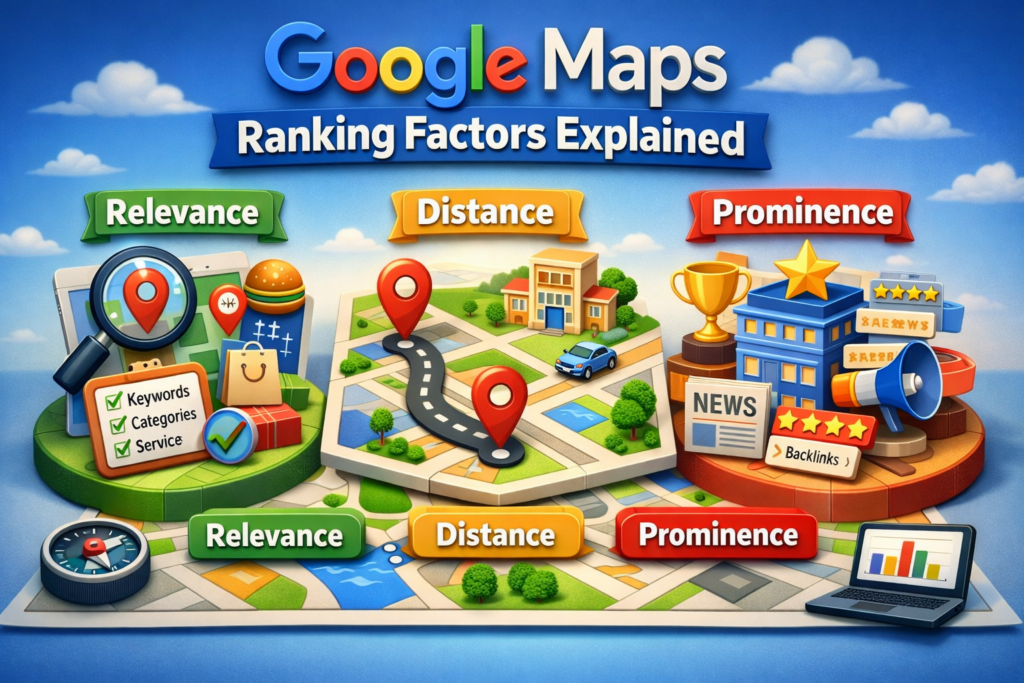
At its core, Google evaluates three primary factors:
Relevance
Relevance measures how closely your business matches the user’s search query. This is determined by your Google Business Profile information, categories, services, and content.
Distance
Distance refers to how close your business is to the location specified in the search. Even when users do not include a location, Google estimates proximity based on their device or search behavior.
Prominence
Prominence reflects how well-known and trustworthy your business appears online. Reviews, citations, backlinks, and brand mentions all influence this factor.
Understanding these pillars is essential when reviewing google maps ranking factors explained, because every optimization effort ties back to one or more of them.
Google Maps Ranking Factors Explained in Detail
Google Business Profile Optimization
One of the most common reasons businesses experience poor visibility is improper Google Business Profile optimization. If you are wondering why Google Business Profile not ranking, this is usually the first place to look.
Google relies heavily on the accuracy and completeness of your profile to understand your business.
Key optimization areas include:
- Correct primary and secondary business categories
- A clear, keyword-aligned business description
- Accurate service listings and attributes
- Updated business hours and contact details
- Regular activity through posts and updates
An incomplete or poorly optimized profile sends weak relevance signals, leading to local SEO ranking problems even if your business is legitimate.
NAP Consistency and Local Citations
NAP stands for Name, Address, and Phone number. Google expects this information to be consistent across your website, Google Business Profile, and third-party directories.
Inconsistent listings confuse search engines and reduce trust. Over time, this can limit your ability to rank in Google Maps.
To avoid this issue:
- Ensure identical business details everywhere online
- Audit major directories for outdated listings
- Avoid variations in business name or address formatting
Strong citation consistency reinforces prominence and helps improve local search visibility.
Reviews and Engagement Signals
Reviews play a critical role in Google Maps rankings. They not only influence trust but also act as ongoing engagement signals.
Google evaluates:
- Review volume and frequency
- Overall rating trends
- Keywords naturally used in reviews
- Business responses to customer feedback
Ignoring reviews is one of the most overlooked local SEO mistakes small businesses make. When businesses actively manage reviews, they signal trustworthiness and customer engagement to Google.
Location Accuracy and Proximity Signals
Distance remains a ranking factor you cannot fully control, but accuracy matters. Businesses must ensure their location pin is placed correctly on Google Maps.
For service-area businesses, defining service regions clearly helps Google understand relevance without misleading proximity signals.
Incorrect location data often leads to visibility drops, especially when competing with nearby businesses that have optimized their geographic signals.
Common Local SEO Ranking Problems That Hurt Google Maps Visibility
Many businesses face ranking issues not because of penalties, but due to overlooked fundamentals.
Common local SEO ranking problems include:
- Incomplete or inactive Google Business Profile
- Wrong primary category selection
- Duplicate or suspended listings
- Outdated business information
- Low review activity and engagement
Addressing these issues early prevents long-term ranking stagnation and improves local performance steadily.
Why Google Business Profile Is Not Ranking?
If you have optimized your profile but still see limited results, you may be asking why Google Business Profile not ranking despite your efforts.
Several hidden factors can affect performance:
- New profiles lacking historical trust signals
- Profile guideline violations, even unintentional ones
- Weak online authority beyond Google Maps
- Limited local brand mentions or backlinks
- Poor on-site local SEO support
Ranking issues often result from a combination of factors rather than a single mistake. Google rewards consistency and authority built over time.
Local SEO Mistakes Small Businesses Make
Understanding what not to do is just as important as knowing best practices.
Some of the most common local SEO mistakes small businesses make include:
- Adding keywords unnaturally to the business name
- Ignoring customer reviews or failing to respond
- Using generic website content without local intent
- Creating multiple listings for the same location
- Neglecting mobile and page speed optimization
These mistakes can limit rankings or even trigger profile suspensions, making recovery more difficult.
How to Improve Local Search Visibility Step by Step?
If your goal is sustainable growth, focusing on gradual improvements works best. Here is how to improve local search visibility in a structured way.
Optimize Google Business Profile Completely
Fill every available field accurately and keep your profile updated with fresh content.
Strengthen Local Authority
Build quality citations, earn local backlinks, and encourage genuine customer reviews.
Create Location-Focused Content
Develop service pages that clearly mention your city, service areas, and local intent.
Improve User Experience
Ensure your website loads quickly, works smoothly on mobile devices, and provides clear contact information.
Each of these steps strengthens relevance, prominence, and trust, which are central to google maps ranking factors explained.
On-Page SEO Factors That Support Google Maps Rankings
Google Maps rankings do not exist in isolation. Your website plays a supporting role.
Important on-page elements include:
- Location-optimized landing pages
- Clear internal linking between service and location pages
- Local business schema markup
- Consistent NAP placement across the site
Strong on-page SEO reinforces Google Maps signals and helps stabilize rankings.
Tracking and Measuring Google Maps Performance
Optimization without tracking leads to guesswork. Businesses should monitor performance regularly to identify improvements or issues early.
Key metrics to track include:
- Search impressions and visibility
- Calls, website clicks, and direction requests
- Ranking positions for local keywords
- Review growth and engagement trends
Tracking helps identify ongoing local SEO ranking problems and allows timely corrections.
Google Maps Ranking Factors Explained: Practical Checklist
To summarize, successful local visibility depends on the following:
- Fully optimized Google Business Profile
- Accurate and consistent NAP information
- Active review management
- Strong local relevance signals
- Reliable on-site SEO support
Following this checklist ensures your efforts align with Google’s expectations and long-term ranking stability.
Frequently Asked Questions
How long does Google Maps SEO take to show results?
Most businesses see gradual improvements within a few weeks, while competitive areas may require several months of consistent optimization.
Can a business rank on Google Maps without a physical location?
Yes, service-area businesses can rank if their profiles are set up correctly and supported by strong local signals.
Why does a Google Business Profile ranking drop suddenly?
Ranking drops often occur due to data changes, competitor activity, guideline issues, or reduced engagement signals.
How often should Google Business Profile be updated?
Regular updates help maintain relevance. Posting updates, responding to reviews, and refreshing services keeps your profile active.
Final Thoughts
Understanding google maps ranking factors explained gives you a clear advantage in local search. Ranking issues rarely occur without reason. When you address local remember relevance, trust, and engagement consistently, visibility improves naturally.
By avoiding common mistakes, optimizing your Google Business Profile correctly, and focusing on long-term authority, you can overcome local SEO ranking problems and improve local search visibility in a sustainable way.


