


Getting traffic from Google is no longer about finding a few popular keywords and placing them into a blog post. Today, you need a keyword research strategy that connects search intent, content quality, technical performance, and topic depth. When all of these work together, your content has a much better chance of ranking, earning clicks, and staying visible over time.
Many websites publish article after article, but still fail to move up in search results. The reason is simple. They create content without a clear keyword research strategy. They target the wrong terms, ignore user intent, and often publish pages that do not offer enough value. In many cases, the problem is not effort. It is direction.
A strong keyword research strategy helps you understand what your audience is searching for, why they are searching for it, and what kind of content Google is rewarding for those searches. It gives structure to your topics, helps you build authority, and prevents wasted content efforts. It also supports GEO, AEO, and voice search because modern search visibility depends on clear answers, contextual relevance, and well organized content.
In this guide, we will break down how to build a practical keyword research strategy for better rankings. We will look at how to find the right keywords, group them by intent, connect them with a smart content framework, and turn that research into pages that deserve to rank.
Table of Contents
What Is a Keyword Research Strategy?
A keyword research strategy is a structured process for discovering, evaluating, grouping, and using search terms that align with your business goals and your audience’s needs. It is not just a list of keywords copied from a tool. It is a plan for deciding what content to create, how to organize it, and which search opportunities are worth pursuing first.
When you follow a real keyword research strategy, you stop guessing. You stop chasing random high volume terms. You start building content around relevance, search intent, and realistic ranking opportunities.
This matters because Google does not rank pages simply because they contain keywords. It ranks pages that solve the user’s problem in the best possible way. Your keyword research strategy should help you create those pages.
Why Keyword Research Matters for Better Rankings?
A solid keyword research strategy helps you in several ways.
First, it improves relevance. Search engines can better understand what your page is about when your topic, subtopics, and user intent are aligned.
Second, it improves content planning. Instead of publishing disconnected articles, you create a clear content path that builds authority.
Third, it supports conversions. The right keyword is not always the one with the highest search volume. Often, the best keyword is the one that brings the most qualified visitor.
Finally, it helps you compete more intelligently. A smart keyword research strategy helps you find realistic opportunities instead of battling huge sites for broad terms that are difficult to win.
Why Many Websites Fail to Rank?
A lot of websites publish content regularly and still struggle. That happens because content without direction rarely performs well.
One common issue is weak intent matching. A page may target an informational keyword but try to sell too aggressively. Another page may target a commercial term but fail to answer practical buying questions. If your content does not match the reason behind the search, rankings become harder to earn.
Another issue is poor topic selection. Many site owners pick keywords based only on volume. They ignore competition, context, and business relevance. That leads to content that may attract impressions but not meaningful clicks.
Then there are thin content seo problems. These happen when a page covers a topic too lightly, repeats surface level points, or offers little more than what is already available on other websites. Search engines do not reward shallow content just because it includes keywords. They reward usefulness.
This is where a proper competitor keyword analysis makes a difference. It helps you identify valuable opportunities and avoid content that feels empty, repetitive, or misaligned.
Start With Search Intent, Not Just Search Volume
Search intent should shape every keyword research strategy. Before you choose a keyword, you need to understand what the user expects to find.
In most cases, intent falls into a few broad categories:
Here is a clear table version with keyword research strategy added naturally:
| Search Intent | What It Means | What the User Wants | Common Search Examples | Best Content Type |
|---|---|---|---|---|
| Informational Intent | The user wants to learn or understand something. | Definitions, explanations, guides, tutorials, or step by step help. | what is SEO, how to do keyword research, technical SEO guide | Blog posts, tutorials, beginner guides, explainer pages |
| Commercial Intent | The user is researching options before making a decision. | Comparisons, reviews, best tools, top services, or alternatives. | best SEO tools, top keyword research platforms, Ahrefs vs Semrush | Comparison pages, review articles, listicles, service comparison content |
| Transactional Intent | The user is ready to take action. | Buying, booking, signing up, requesting a quote, or contacting a business. | buy SEO services, book SEO audit, contact SEO agency | Service pages, product pages, landing pages, contact pages |
| Navigational Intent | The user wants to reach a specific website, brand, or page. | Direct access to a known brand, tool, or webpage. | Google Search Console login, Semrush homepage, ClickQuanta blog | Homepage, login pages, brand pages, specific landing pages |
A strong keyword analysis does not stop at finding search terms. It also studies the intent behind each keyword. When your content matches user intent and the right content type, you improve relevance, user satisfaction, and ranking potential.
Build Your Keyword List the Right Way
A successful keyword research strategy begins with the right source material. You need more than one seed keyword. You need a broad view of your audience’s questions, challenges, and goals.
Start with your core topic. In this case, that topic is keyword research for SEO performance. Then expand into related terms, user questions, modifiers, and supporting phrases.
You should look for:
- Core head terms
- Long tail keywords
- Question based queries
- Comparison terms
- Problem solving phrases
- Topical subthemes
This is also where an SEO Content Plan Guide becomes useful. Once you gather keywords, you should not treat them as isolated terms. You should organize them into a system. That system tells you which pages to create first, which pages support others, and how topics connect across your site.
A practical keyword planning always leads into an SEO Content Plan Guide, because research without execution does not create rankings.
Use Long Tail Keywords to Capture Better Opportunities
Long tail keywords are often easier to rank for because they are more specific. They also tend to reflect clearer intent.
For example, a broad keyword like “keyword research” is highly competitive and vague. But a phrase like “keyword research strategy for local SEO blog posts” tells you much more about what the user wants.
This is why long tail targeting is a key part of any effective keyword research strategy. It helps you reach users who are closer to action, asking more precise questions, and looking for more targeted answers.
Long tail keywords also work well for voice search. People speak more naturally than they type. They ask complete questions. They use conversational phrasing. A modern keyword research strategy should include these natural language patterns so your content performs better in both search and voice environments.
Group Keywords Into Clusters
One of the biggest mistakes in SEO is creating a separate page for every slight keyword variation. That often leads to thin pages, weak coverage, and cannibalization.
A better approach is keyword clustering. In a strong keyword research strategy, you group related keywords under one broader topic and assign them to the same page when they share similar intent.
For example, one article can often cover:
- keyword research strategy
- best keyword research process
- how to do keyword research for SEO
- keyword planning for better rankings
This helps your content feel more complete. It also helps Google understand the page more deeply. The result is stronger topical relevance and better ranking potential.
Keyword clustering is also helpful when planning long-form content in SEO. A long article can naturally include supporting phrases, subtopics, and related questions without becoming repetitive.
Why Content Depth Matters
Search engines have become much better at understanding whether a page truly covers a topic or just touches the surface. That is why long-form content in SEO often performs well when the topic requires detail.
This does not mean every article must be long. It means the article should be as deep as the search intent demands. A broad educational topic often needs strong coverage, clear examples, and multiple supporting sections. In these cases, long-form content in SEO gives you room to answer related questions and include semantically connected ideas.
At the same time, you need to avoid fluff. Word count alone does not create value. The goal is comprehensive usefulness, not unnecessary length.
The opposite of this is what leads to thin content seo problems. Pages with limited explanation, weak subtopic coverage, and little original value often struggle to compete. They may get indexed, but they rarely become strong ranking assets.
A smart keyword clustering protects you from that by showing you what depth the topic requires before you even begin writing.
Connect Keyword Research With Technical SEO

Even the best content can underperform if your site has technical barriers. That is why every complete keyword research strategy should work alongside a technical SEO guide.
Your keyword targeting may be excellent, but if search engines cannot crawl your pages properly, render the content well, or understand the structure of the page, your results will suffer.
A technical SEO guide helps you review the foundation that supports keyword performance. This includes:
- crawlability
- indexing
- internal linking
- mobile usability
- page speed
- schema markup
- heading structure
When your keyword research strategy is paired with a sound technical SEO guide, you give your content a much stronger chance to rank. Search engines need both relevance and accessibility. One without the other limits your growth.
Turn Research Into a Content Plan
A good keyword research strategy should always end with a clear publishing plan. This is where an SEO Content Plan Guide becomes essential.
Once you collect and cluster keywords, map them into content types. Some keywords belong in blog posts. Others fit service pages, landing pages, comparison pages, or FAQ sections.
Your SEO Content Plan Guide should answer a few core questions:
- What is the primary keyword for this page?
- What supporting terms belong on the same page?
- What intent does this page serve?
- What internal links should connect to and from this page?
- Where does this page fit in the customer journey?
When you follow an SEO Content Plan Guide, every piece of content has a purpose. Nothing is random. Nothing is published just to fill space. That structure is what helps your website build authority over time.
How AI Can Support Smarter Content Research?
AI can speed up parts of the process when used carefully. For example, ChatGPT can generate content ideas based on a topic cluster, common audience questions, or a keyword theme. It can help you brainstorm angles, outline article sections, and uncover supporting subtopics you may want to include.
Still, AI should support your process, not replace your judgment. ChatGPT can generate content ideas, but you still need to evaluate whether those ideas fit search intent, business goals, and real user needs.
Used the right way, ChatGPT can generate content ideas that save time during brainstorming and topic expansion. It can also help you discover question based queries that support AEO and voice search.
The best approach is to let AI assist with speed while you stay in control of strategy, quality, and originality.
Optimize for GEO, AEO, and Voice Search
Modern SEO is not only about blue links. Search visibility now includes AI summaries, featured answers, and spoken responses. That means your keyword research strategy should support GEO, AEO, and voice search from the beginning.
For GEO, you need semantic coverage. Search systems are getting better at understanding entities, relationships, and context. Your content should cover the topic naturally and completely, not just repeat the exact keyword.
For AEO, you need direct answers. Use clear subheadings, concise definitions, short paragraphs, and question based formatting. This makes it easier for search engines to pull your content into answer driven formats.
For voice search, use conversational language. Many users speak queries as full questions. They want quick, clear, and trustworthy responses. A modern keyword research strategy should include these natural phrasing patterns so your content can serve both typed and spoken searches.
A Practical Keyword Research Strategy You Can Follow
Here is a simple process you can use.
| Step | Simple Explanation |
|---|---|
| Choose a Core Topic | Pick a topic that fits your business, audience, and website goals. |
| Collect Seed Keywords | List broad terms, questions, pain points, and goals related to that topic. |
| Expand Into Variations | Find long tail keywords, related phrases, and search modifiers. |
| Analyze Intent | Understand whether users want information, comparison, or action. |
| Cluster Related Terms | Group keywords with similar intent into one content theme. |
| Prioritize by Opportunity | Choose keywords based on relevance, ranking difficulty, and business value. |
| Map Keywords to Content | Match keyword groups to blogs, guides, service pages, and FAQs. |
| Review Technical Support | Use a technical SEO guide to ensure strong crawlability and indexability. |
| Publish With Depth | Cover the topic properly and use long-form content in SEO where needed. |
| Refresh Over Time | Update rankings, improve pages, and refine your keyword research strategy regularly. |
Common Keyword Research Mistakes to Avoid
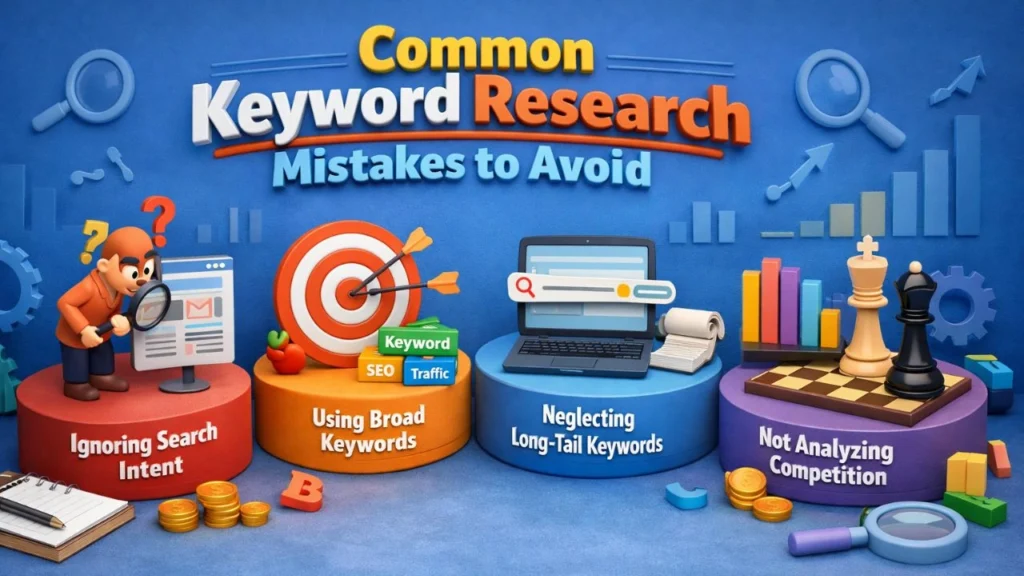
A lot of ranking problems begin with avoidable mistakes.
One mistake is targeting only high volume terms. Those keywords may look attractive, but they are often too broad and too competitive.
Another mistake is ignoring page purpose. Every page should have one clear target and a defined role in your content system.
A third mistake is publishing low value content. This is where thin content seo problems often begin. When a page lacks depth, originality, or structure, it becomes difficult to rank.
Another common issue is skipping internal links. Your pages should support one another. A good keyword research strategy includes a linking framework that builds topical relationships across the site.
Finally, many site owners fail to measure results. Keyword research is not complete when the article goes live. You need to monitor impressions, clicks, rankings, and user behavior so you can improve the page later.
Final Thoughts
A successful keyword research strategy is not about finding the most keywords. It is about finding the right opportunities and turning them into useful, well structured content.
When your keyword research strategy is connected to search intent, supported by an SEO Content Plan Guide, strengthened by a technical SEO guide, and shaped with enough depth to avoid thin content seo problems, your content becomes far more competitive.
This is also why long-form content in SEO still matters when the topic deserves strong coverage. It gives you room to answer real questions, build context, and create pages that feel complete. And when you use AI wisely, ChatGPT can generate content ideas that help you brainstorm faster without replacing human expertise.
If your goal is to rank on the first page of Google, do not treat keyword research as a one time task. Treat it as the foundation of your content system. The stronger your keyword research strategy, the stronger your chances of earning sustainable search visibility.
Frequently Asked Questions
What is a keyword research strategy?
A keyword research strategy is a structured plan for finding, evaluating, organizing, and using keywords based on user intent, competition, and business relevance.
Why is keyword research important for rankings?
It helps you target the right topics, match search intent, improve relevance, and build a stronger content structure that search engines can understand.
How do I avoid thin content SEO problems?
Focus on usefulness, not just word count. Cover the topic properly, answer related questions, and avoid publishing shallow pages with little original value.
Why does long form content help SEO?
Long-form content in SEO can perform well because it gives you space to cover subtopics, answer follow up questions, and create stronger topical relevance when the subject needs depth.
How does technical SEO support keyword rankings?
A technical SEO guide helps ensure that your content is crawlable, indexable, fast, mobile friendly, and easy for search engines to interpret.
Can AI help with keyword research?
Yes. ChatGPT can generate content ideas, suggest subtopics, and help organize outlines, but human review is still necessary for quality, accuracy, and strategic fit.
What is the role of an SEO Content Plan Guide?
An SEO Content Plan Guide helps you map keywords to the right pages, prevent cannibalization, organize topic clusters, and publish content in a more strategic way.
How often should I update my keyword strategy?
Review it regularly. Search trends, competition, and your own site authority can change over time, so your keyword research strategy should evolve as your content grows.

